

















Electrochemical Fundamentals of Saltwater Chlorination
Industrial titanium anodes generate high-purity sodium hypochlorite directly within recirculating pool water by driving the chlorine evolution reaction across an electrocatalytic surface. This electrolytic pathway eliminates hazardous bulk chemical storage while sustaining stable sanitization levels across high-turnover aquatic facilities.
The on-site chlorination process relies on feeding low-salinity brine (typically 2,500 to 5,000 ppm NaCl) through an electrolytic flow cell. When direct electric current passes through the cell, oxidation and reduction reactions occur simultaneously at the electrode surfaces.
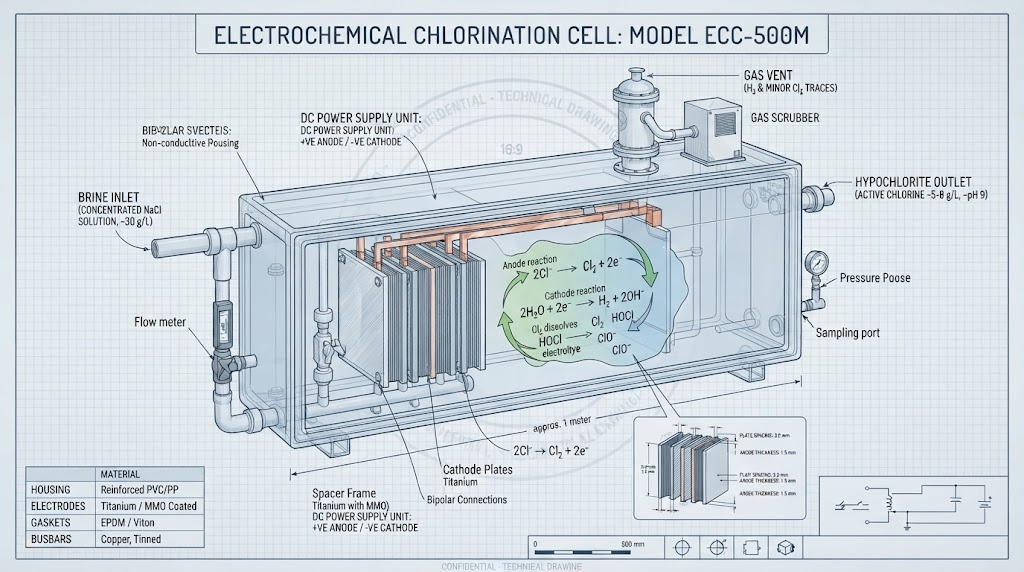
At the anode surface, chloride ions undergo electrochemical oxidation via the Chlorine Evolution Reaction (CER):
Primary Anodic Reaction: 2Cl⁻ → Cl₂ (aq) + 2e⁻ (E° = +1.358 V vs. SHE)
At the cathode, water reduction produces hydroxide ions and hydrogen gas:
Cathodic Reduction: 2H₂O + 2e⁻ → H₂ (g) + 2OH⁻ (E° = -0.828 V vs. SHE)
The dissolved aqueous chlorine instantly hydrolyzes in the alkaline boundary layer adjacent to the cathode, forming hypochlorous acid (HOCl) and hypochlorite ions (OCl⁻):
Solution Hydrolysis: Cl₂ + H₂O ⇌ HOCl + H⁺ + Cl⁻
In-Situ Neutralization: HOCl + OH⁻ ⇌ OCl⁻ + H₂O
A parasitic side-reaction, the Oxygen Evolution Reaction (OER), competes directly with chlorine generation:
Parasitic Anodic Reaction: 2H₂O → O₂ (g) + 4H⁺ + 4e⁻ (E° = +1.229 V vs. SHE)
Optimizing electrocatalytic selectivity toward CER over OER is paramount. Operating an unoptimized anode results in high parasitic oxygen evolution, which degrades the precious metal oxide catalytic matrix, spikes cell voltage, and collapses overall Faradaic efficiency below 65%.
Engineered MMO Titanium Anodes maintain an ultra-low chlorine overpotential ($\eta_{\text{CER}} < 40\text{ mV}$) while enforcing a high oxygen evolution overpotential ($\eta_{\text{OER}} > 350\text{ mV}$). This yields commercial Faradaic efficiencies between 85% and 92% in dilute chloride electrolytes.
MMO Coating Formulations: Ru-Ir vs. Ir-Ta Chemistry
The electrochemical performance and operational lifespan of an industrial pool anode depend on the crystal morphology and solid-solution ratio of its catalytic metal oxide shell.
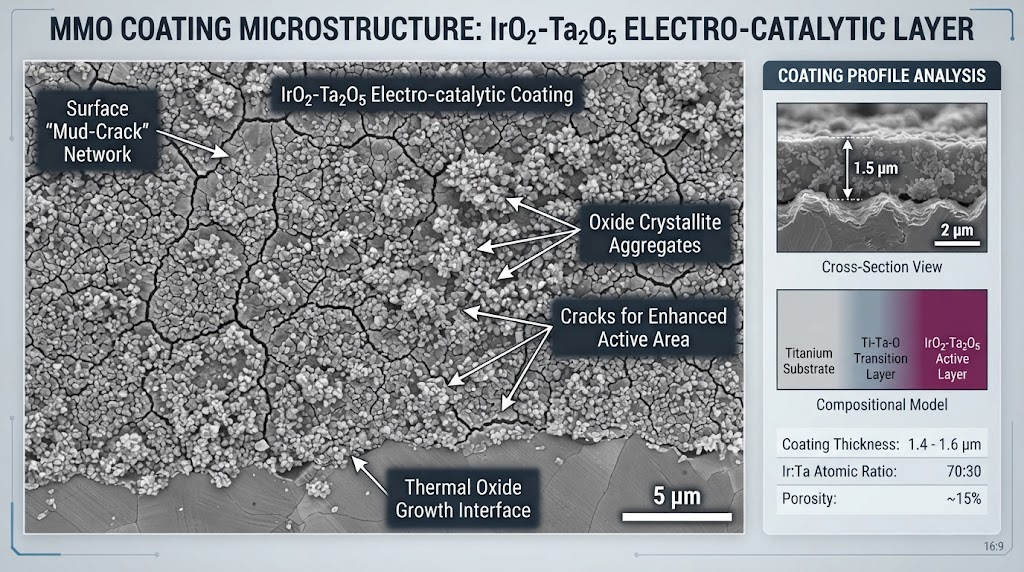
Ruthenium dioxide ($\text{RuO}_2$) exhibits the lowest known overpotential for chlorine evolution, making it the most catalytically active electrocatalyst for dilute brine electrolysis. However, pure $\text{RuO}_2$ suffers from rapid dissolution under anodic polarization when oxygen evolution occurs concurrently.
To stabilize the crystalline lattice, Iridium dioxide ($\text{IrO}_2$) is introduced. $\text{IrO}_2$ provides strong corrosion resistance against nascent oxygen attack, protecting the ruthenium active centers from valence degradation and dissolution.
| Coating Chemistry | Catalytic System | Target Application | Current Density Range | Relative CER Selectivity |
|---|---|---|---|---|
| Standard Ru-Ir | $\text{RuO}_2\text{-IrO}_2\text{-TiO}_2$ | Monopolar steady-state flow systems | $300 - 800\text{ A/m}^2$ | High ($> 90\%$) |
| Heavy-Duty Ir-Ta | $\text{IrO}_2\text{-Ta}_2\text{O}_5$ | High-sulfate, low-chloride freshwater | $500 - 1500\text{ A/m}^2$ | Moderate ($70 - 80\%$) |
| Quaternary DuraChlor™ | $\text{RuO}_2\text{-IrO}_2\text{-Ta}_2\text{O}_5\text{-TiO}_2$ | Reverse-polarity self-cleaning cells | $400 - 1200\text{ A/m}^2$ | Very High ($> 88\%$) |
Commercial aquatic facilities frequently utilize automated polarity reversal (alternating current directions every 2 to 4 hours) to clear calcium carbonate ($\text{CaCO}_3$) scale from cathode surfaces without manual acid washing. This reverse polarization imposes severe electrochemical stress on standard electrodes.
During the cathodic cycle, residual protons intercalate into standard oxide coatings, causing mechanical lattice expansion, cracking, and rapid detachment of the active layer. China Titanium Factory solves this failure mode with a proprietary quaternary formulation ($\text{RuO}_2\text{-IrO}_2\text{-Ta}_2\text{O}_5\text{-TiO}_2$).
The addition of tantalum pentoxide ($\text{Ta}_2\text{O}_5$) acts as a structural grain-boundary stabilizer, preventing proton entry into the sub-surface matrix and yielding superior resistance to cyclic polarity switching.
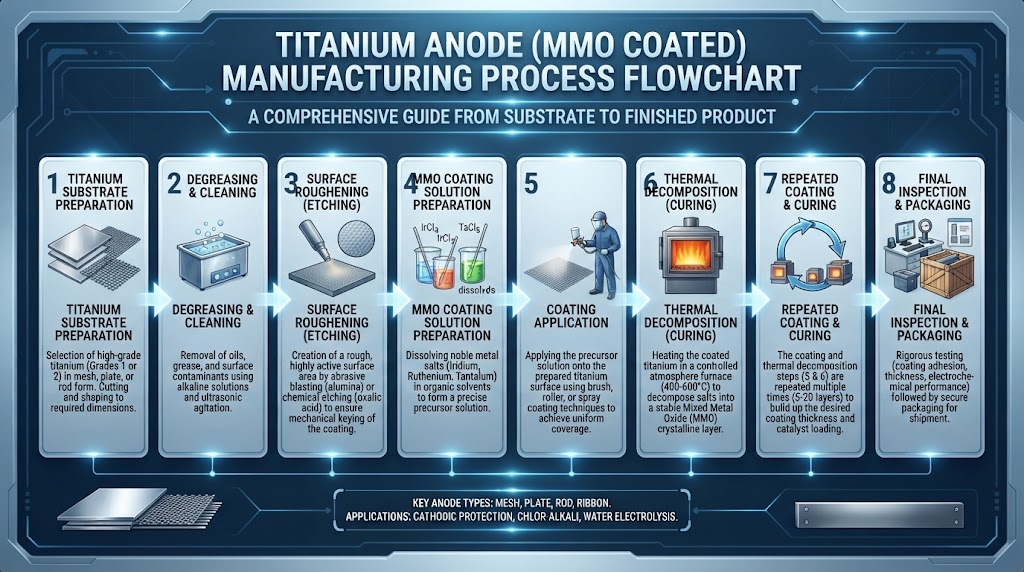
The DuraChlor™ 5-Step MMO Optimization Protocol
Electrode failure in pool chlorination rarely stems from catalyst exhaustion alone. More often, it occurs due to poor coating-to-substrate adhesion, resulting in premature interface peeling. We eliminate this issue using the standardized DuraChlor™ 5-Step MMO Optimization Protocol across our production facilities.
Step 1: Substrate Selection and Vacuum Annealing
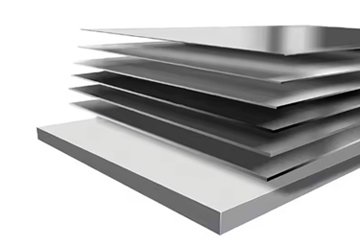
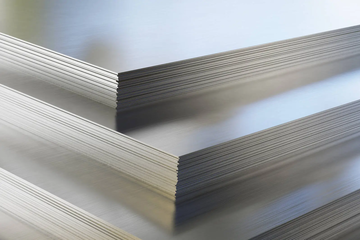
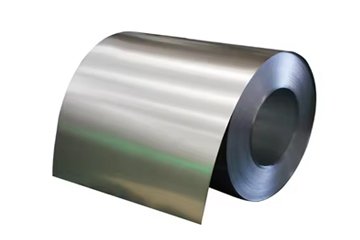
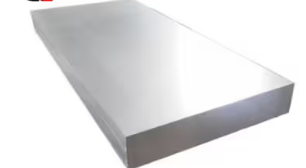
Every anode begins with certified Titanium Plates ASTM B265 Grade 1. Unalloyed Grade 1 titanium provides maximum ductility and minimal interstitial impurities ($\text{Fe} \le 0.20\%, \text{O} \le 0.18\%$). Vacuum annealing at 650°C for 4 hours relieves internal rolling stresses, ensuring zero dimensional distortion during service.
Step 2: Surface Micro-Texturing and Oxalic Acid Etching
Substrates undergo automated corundum blasting to establish a controlled micro-roughness profile ($R_a = 3.5 - 5.0\ \mu\text{m}$). Plates are subsequently etched in boiling $10\%$ oxalic acid ($\text{H}_2\text{C}_2\text{O}_4$) at 95°C for 2 hours. This produces a micro-pitted hydrided titanium interface that creates interlocking anchors for the catalytic layers.
Step 3: Precision Thermal Decomposition Coating
Precursor precious metal salts dissolved in high-purity alcoholic solvents are applied via robotic multi-axis spray systems. The substrate undergoes 18 to 26 discrete coating-and-baking iterations. Thermal decomposition takes place in oxygen-controlled kilns at 450°C–500°C, forming a rutile-phase crystalline solid solution with total catalyst loading calibrated from $8\text{ g/m}^2$ to $25\text{ g/m}^2$.
Step 4: Accelerated Life Testing (ALT) Validation
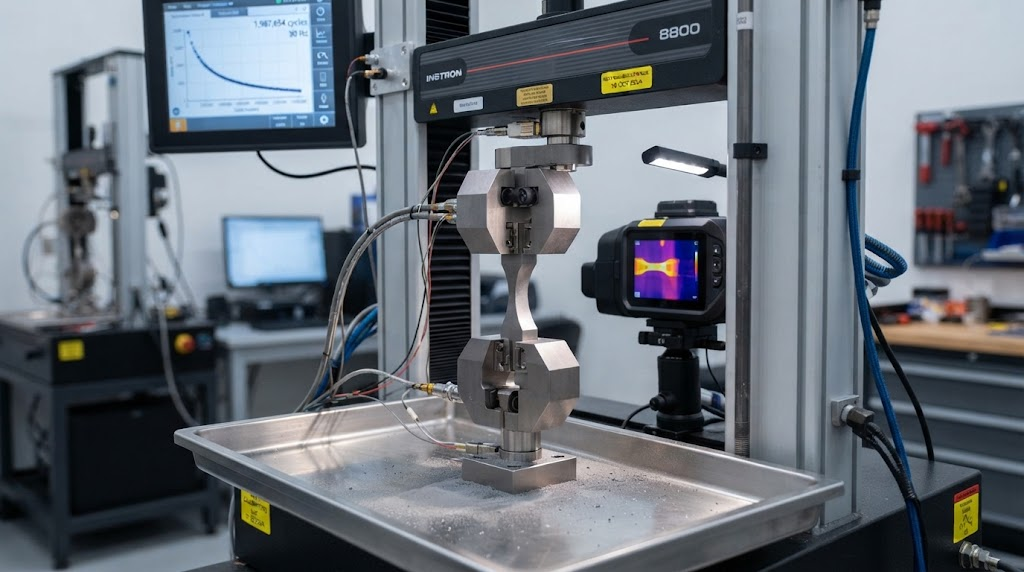
Representative batch coupons undergo destructive accelerated life testing according to NACE/AMPP TM0108 protocols. In a $1.0\ \text{M}\ \text{H}_2\text{SO}_4$ electrolyte at an extreme current density of $10,000\text{ A/m}^2$ and 40°C, the coating must exceed 120 hours before reaching a 5-volt cell degradation cutoff, confirming an industrial operating lifespan of 5+ years under standard pool parameters.
Step 5: Ultrasonic and Helium Leak Integrity Testing
Completed structural assemblies, including conductor busbars and mounting studs, undergo non-destructive ultrasonic interface scans. Welded titanium housing junctions are tested via Helium Mass Spectrometry to verify hermetic seals and ensure zero electrolyte ingress into internal electrical connections.
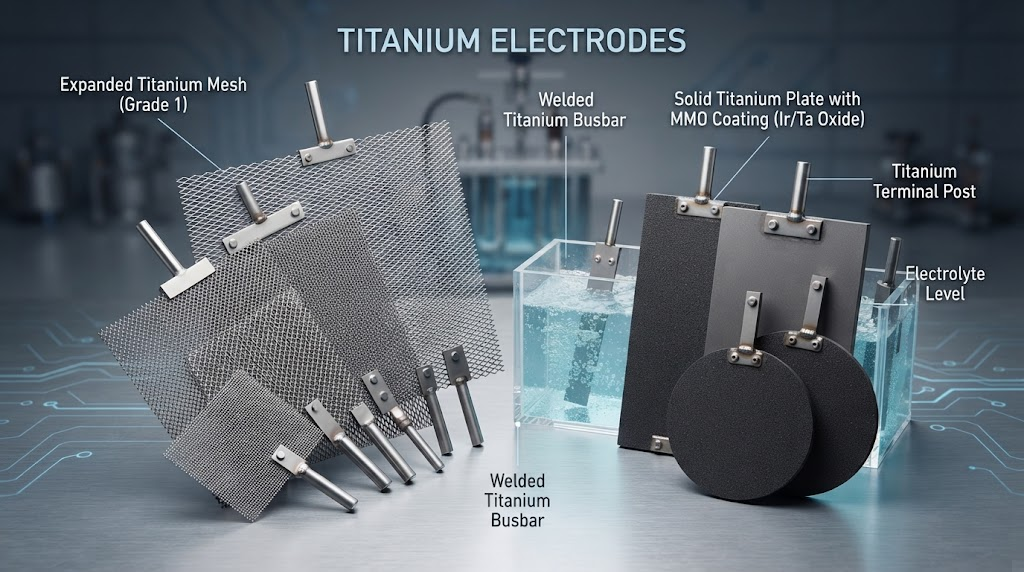
Electrode Structural Geometries: Plate, Mesh, and Tubular
Selecting the proper electrode geometry governs cell hydrodynamics, gas bubble detachment dynamics, and overall chlorination efficiency.
Expanded Titanium Mesh Anodes
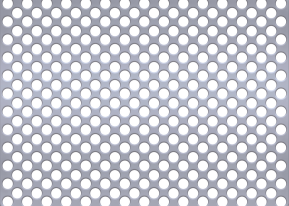
Expanded mesh geometries are the preferred choice for commercial high-flow systems. Using Titanium Mesh for Water Treatment enhances fluid micro-turbulence, which accelerates the detachment of chlorine and hydrogen gas bubbles from the electrode surface.
Rapid bubble release reduces electrical resistance shielding and minimizes local ohmic drop ($IR\text{-drop}$), maintaining low overall cell voltages. Mesh structures also offer high active surface area-to-weight ratios, reducing overall precious metal costs.
Solid Rolled Plate Anodes
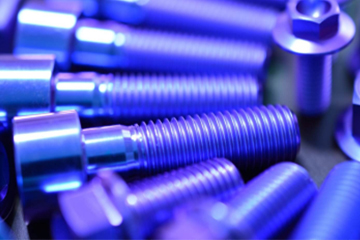
Solid titanium plates are engineered for modular, compact bipolar electrolytic cells. In bipolar configurations, a single plate serves as the anode on one face and the cathode on the reverse. Solid plate assemblies ensure uniform current density distribution across high-amperage arrays ($> 500\text{ A}$), preventing edge-effect localized overpotentials.
Seamless Tubular Titanium Anodes
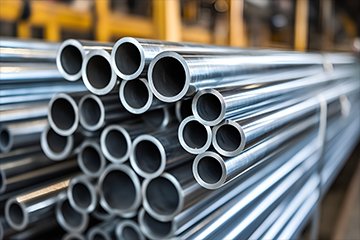
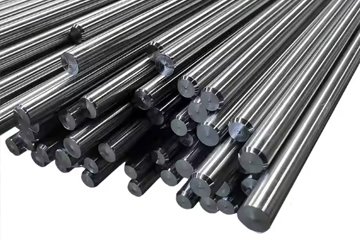
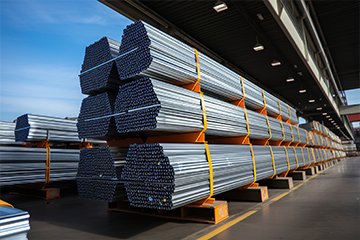
Fabricated from ASTM B338 seamless Grade 1 titanium tubes, concentric tubular anodes are deployed in pressurized inline pool pipelines. Their concentric design delivers an even radial current field, optimal axial fluid flow, and zero dead zones for scale accumulation.
Engineering Sizing Model and Salt-to-Chlorine Matrix
Accurate sizing of an electrochlorination cell requires calculating required free available chlorine (FAC) output from the water turnover rate, peak bather load, and environmental organic demand.
Chlorine production capacity per hour follows Faraday’s Law of Electrolysis:
Mass Output Equation: $m = \frac{M \cdot I \cdot t \cdot \eta}{z \cdot F}$
Where:
• $m$ = Mass of generated chlorine gas ($\text{grams}$)
• $M$ = Molar mass of chlorine gas ($70.906\text{ g/mol}$)
• $I$ = Total cell current ($\text{Amperes}$)
• $t$ = Electrolysis operating duration ($\text{seconds}$)
• $\eta$ = Faradaic current efficiency (typically $0.85 - 0.90$ for DuraChlor™ MMO)
• $z$ = Electrons transferred per mole of $\text{Cl}_2$ ($z = 2$)
• $F$ = Faraday constant ($96,485\text{ C/mol}$)
In practical operational terms, $1\text{ Ampere-hour (Ah)}$ of current theoretically generates $1.323\text{ grams}$ of pure chlorine gas at $100\%$ efficiency. At an operating efficiency of $88\%$, actual yield is approximately $1.164\text{ grams of }\text{Cl}_2\text{ per Ah}$.
| Facility Type | Pool Volume ($\text{m}^3$ / gal) | Required Output ($\text{kg/day Cl}_2$) | Total Cell Current ($\text{Amperes}$) | Required Active Area ($\text{m}^2$) |
|---|---|---|---|---|
| Resort Hotel Pool | $500\text{ m}^3$ / 132k gal | $6.0\text{ kg/day}$ | $215\text{ A}$ | $0.36\text{ m}^2$ |
| Competition Center | $2,500\text{ m}^3$ / 660k gal | $25.0\text{ kg/day}$ | $895\text{ A}$ | $1.49\text{ m}^2$ |
| Commercial Waterpark | $7,500\text{ m}^3$ / 1.98M gal | $90.0\text{ kg/day}$ | $3,220\text{ A}$ | $5.37\text{ m}^2$ |
*Calculations assume a standard commercial current density of $600\text{ A/m}^2$, $88\%$ Faradaic efficiency, and an continuous 24-hour chlorination duty cycle.
OEM Cross-Compatibility, Busbar Welding, and Custom Fabrication
China Titanium Factory supplies custom-engineered drop-in replacement electrode stacks and bespoke chlorination cells for municipal water operators and original equipment manufacturers globally.
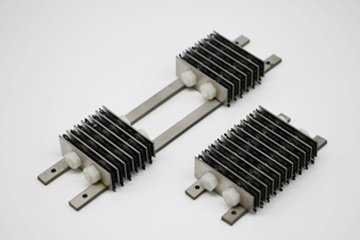
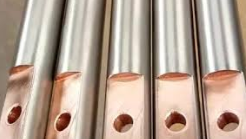
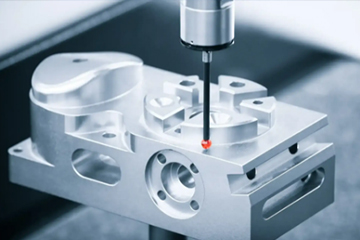
High electrical currents traversing the anode assembly necessitate low-resistance electrical connections. We produce high-precision Titanium CNC Machined Parts, including threaded terminal posts, distribution flanges, and interlocking spacers machined to $\pm 0.02\text{ mm}$ tolerances.
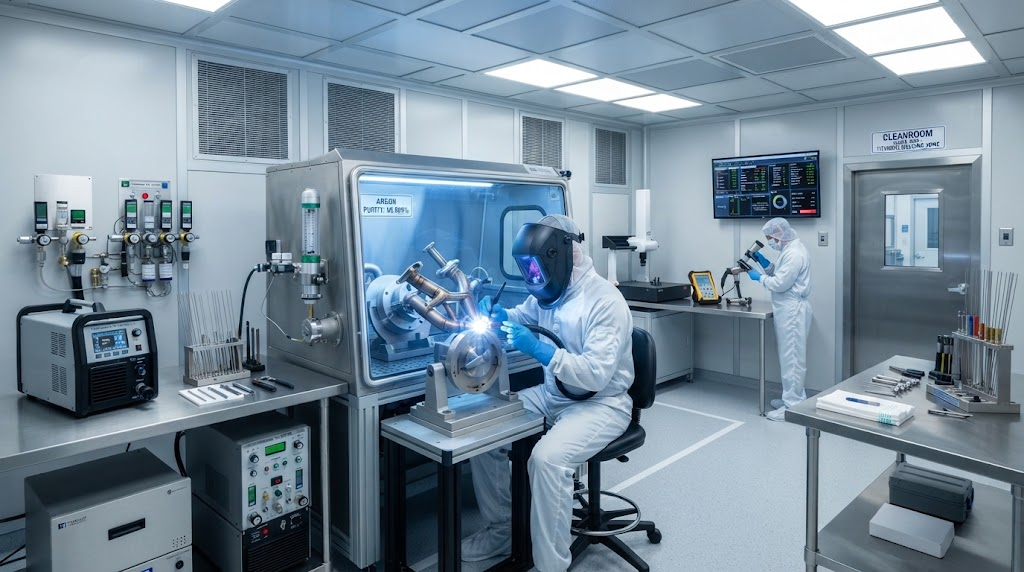
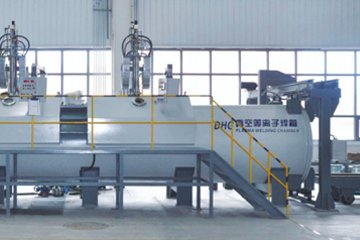
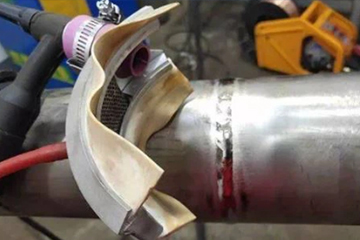
All titanium busbars and current feeder rods are joined using automated, trailing-shield TIG (Tungsten Inert Gas) welding within high-purity argon chambers (oxygen levels below $20\text{ ppm}$). This prevents weld zone embrittlement and preserves the fracture toughness of the titanium joint.
Our custom electrode stacks integrate seamlessly with PVDF, PTFE, or clear cast acrylic cell bodies, ensuring complete drop-in compatibility with legacy commercial electrolytic systems.
Testing Protocols, ASTM Quality Verification, and Recoating Economics
Every anode batch manufactured at China Titanium Factory is backed by comprehensive quality documentation, including raw material Mill Test Reports (MTR) per ASTM B265 and coating morphology verification under ISO 9001:2015 controls.
Accelerated lifetime compliance conforms to NACE/AMPP TM0108 standards for testing catalytic oxide coatings. This standard provides quantifiable operational confidence under high-stress operating conditions.
Titanium is a noble substrate that does not corrode under standard chlorination conditions. When an anode reaches its end of catalytic life (indicated by elevated cell voltage), replacing the entire titanium assembly is financially inefficient.
Our industrial Titanium Recoating & Refurbishing Services restore spent assemblies to factory-new performance specifications:
Chemical De-Coating: Spent oxide residue is stripped in warm, inhibited inorganic acids without degrading or thinning the base titanium structure.
Dimensional Re-Truing: Plates and meshes are realigned to original flatness and dimensional tolerances.
Re-Etching and Re-Coating: Substrates receive fresh chemical surface activation followed by our multi-layer DuraChlor™ MMO coating process.
Recoating existing titanium substrates lowers maintenance and replacement costs by 45% to 60% compared to purchasing new assemblies, significantly improving long-term total cost of ownership (TCO).
Frequently Asked Questions
What is the operational lifespan of an industrial MMO titanium pool anode?
Under recommended operational conditions ($3,000 - 5,000\text{ ppm NaCl}$, current densities between $400 - 800\text{ A/m}^2$, and balanced Langelier Saturation Index), a high-grade $\text{Ru-Ir-Ta}$ anode provides 5 to 8 years (or roughly 35,000 to 50,000 operating hours) of continuous service.
How often should reverse-polarity self-cleaning cycles run?
For pools with moderate calcium hardness ($200 - 400\text{ mg/L CaCO}_3$), reversing polarity every 3 to 4 hours is standard. Facilities with high mineral hardness may shorten cycles to every 2 hours, provided they use our reverse-polarity-stabilized quaternary DuraChlor™ formulation.
Can spent titanium anodes from other manufacturers be recoated?
Yes. We recoat electrode assemblies from any global equipment manufacturer. We chemically strip the spent catalyst, inspect substrate integrity, and apply custom MMO coatings formulated for your facility's operational parameters.
What is the standard manufacturing lead time for custom assemblies?
Standard custom titanium anode plates, meshes, and busbar assemblies are produced within 2 to 3 weeks following drawing approval. Rush manufacturing and express air delivery options are available for emergency facility maintenance requirements.
Upgrade Your Commercial Chlorination Systems
Partner directly with China Titanium Factory for custom MMO titanium plates, expanded meshes, and professional recoating services built to ASTM B265 standards.
Request Engineering Consultation