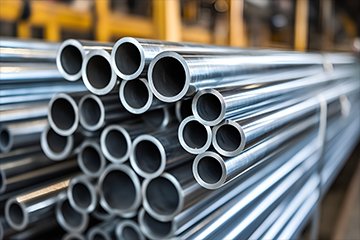
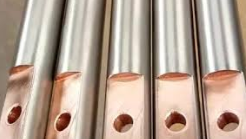
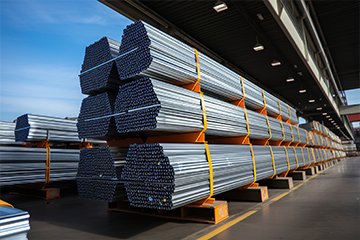
Titanium Grade 9 hydraulic tubing (UNS R56320, Ti-3Al-2.5V) is a seamless near-alpha titanium alloy engineered specifically for severe-duty fluid power circuits in modern flight control and critical industrial actuation systems. It delivers an unmatched combination of high tensile strength, continuous hydraulic impulse fatigue resistance, and absolute chemical immunity to synthetic phosphate ester hydraulic fluids (such as Skydrol) across operating environments ranging from -65°F to 600°F (-54°C to 316°C).
Metallurgically positioned between commercially pure titanium grades and high-strength alpha-beta alloys like Ti-6Al-4V, Grade 9 provides 20% to 50% higher mechanical strength than Grade 2 while retaining exceptional cold workability. This balance allows seamless tubes to undergo intensive rotary draw bending and standard 37° flaring without risk of localized necking or micro-cracking.
"Ti-3Al-2.5V represents the industry benchmark for high-integrity hydraulic infrastructure. Its unique hexagonal close-packed (HCP) crystallographic texture resists circumferential wall thinning under high cyclic pressure spikes."
For flight control surfaces, primary flight actuation, thrust reversers, and subsea hydraulic manifolds, transitioning to high-integrity Aerospace Titanium Tubing directly eliminates dead weight, driving structural efficiency across aerospace and marine platforms.
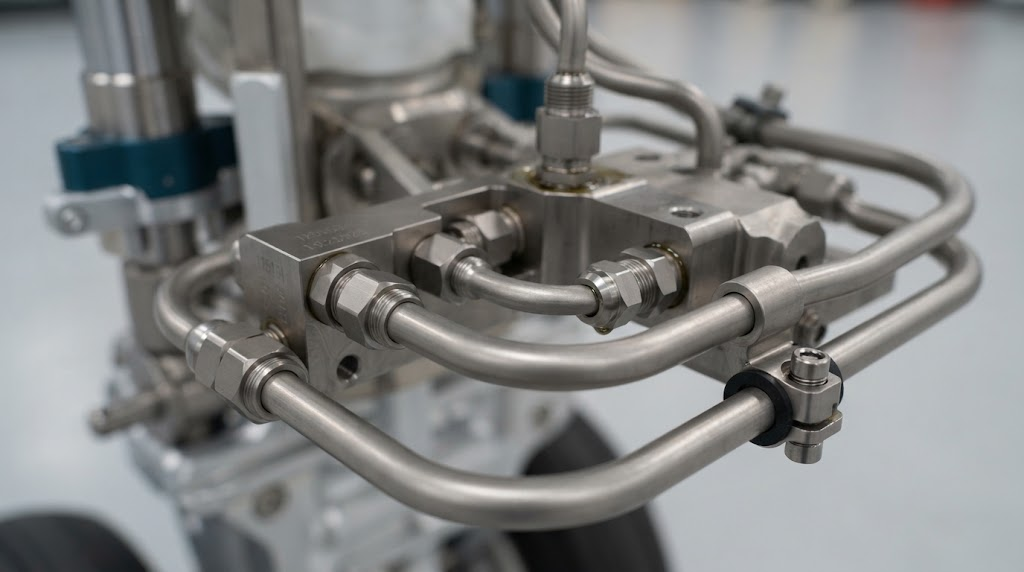
Grade 9 balances aluminum (an alpha stabilizer) and vanadium (a beta isomorphous stabilizer) to create a fine-grained, near-alpha microstructure. Strict control of interstitial elements (oxygen, nitrogen, carbon, and hydrogen) prevents lattice embrittlement and ensures repeatable dynamic impulse behavior.
| Element | Min (wt%) | Max (wt%) | Standard Reference |
|---|---|---|---|
| Aluminum (Al) | 2.50 | 3.50 | ASTM B338 / AMS 4943 |
| Vanadium (V) | 2.00 | 3.00 | AMS 4944 / AMS 4945 |
| Iron (Fe) | — | 0.30 (AMS: 0.25) | Intermetallic Control |
| Oxygen (O) | — | 0.15 (AMS: 0.12) | Lattice Ductility Spec |
| Carbon (C) | — | 0.05 | ASTM B338 |
| Nitrogen (N) | — | 0.02 | Interstitial Hardening Limit |
| Hydrogen (H) | — | 0.015 (150 ppm) | Hydride Prevention |
| Titanium (Ti) | Balance | Balance | Base Matrix |
Titanium Grade 9 is primarily deployed in two distinct metallurgical tempers, governed by SAE AMS specifications:
Cold Worked and Stress Relieved (CWSR / AMS 4944): Developed through cold pilgering and reduction (35% to 50% cross-sectional area reduction) followed by a recovery heat treatment at 700°F–800°F (371°C–427°C). This treatment yields ultimate tensile strengths exceeding 860 MPa, tailored for dynamic 3,000 to 5,000 psi hydraulic runs.
Annealed (AMS 4943): Fully recrystallized through vacuum heat treatment at 1200°F–1450°F (649°C–788°C). This temper offers higher elongation (≥15%), suited for complex secondary flared connections and severe draw bending.
| Mechanical Property | Annealed (AMS 4943) | CWSR (AMS 4944) | Engineering Significance |
|---|---|---|---|
| Ultimate Tensile Strength (UTS) | ≥ 620 MPa (90 ksi) | ≥ 862 MPa (125 ksi) | Governs maximum burst containment |
| Yield Strength (0.2% Offset) | ≥ 483 MPa (70 ksi) | ≥ 724 MPa (105 ksi) | Determines proof pressure ceiling |
| Elongation in 2 inches (50 mm) | ≥ 15% | ≥ 10% | Ensures safe flaring and cold bending |
| Modulus of Elasticity (Tension) | 100 GPa (14.5 × 10⁶ psi) | 105 GPa (15.2 × 10⁶ psi) | Absorbs severe hydraulic water hammer |
| Hardness (Rockwell C) | 24–28 HRC | 30–35 HRC | Resists vibration fretting at clamp blocks |
The fatigue life of Grade 9 hydraulic tubing is governed by crystallographic texture control during cold pilger reduction. By configuring the ratio of wall thickness reduction ($R_w$) to outer diameter reduction ($R_d$), the basal poles $(0002)$ of the hexagonal close-packed titanium lattice align radially rather than circumferentially.
This radial basal texture yields a high Contractile Strain Ratio (CSR > 1.5):
Engineering Formula:
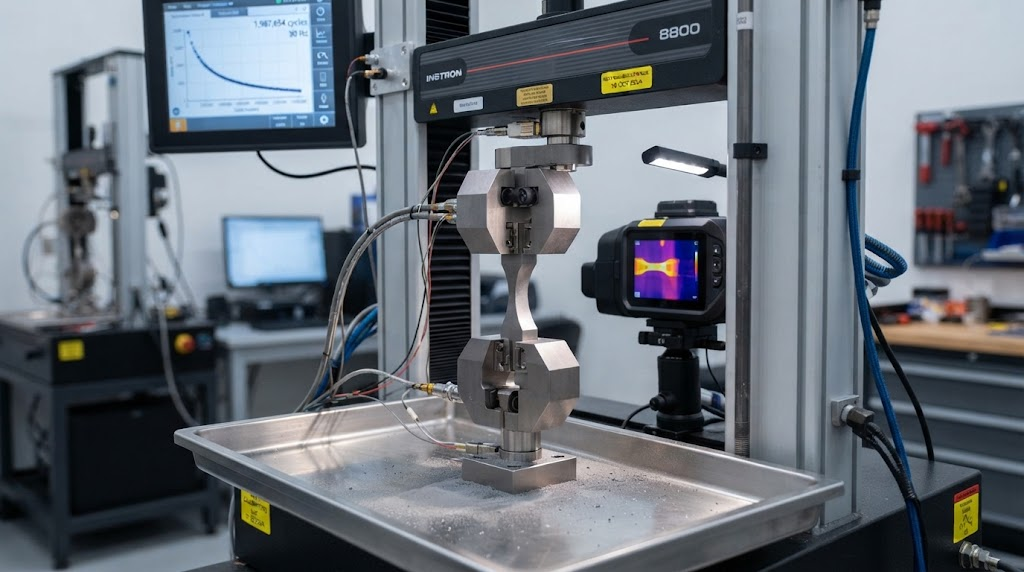
$$\text{CSR} = \frac{\epsilon_w}{\epsilon_t} = \frac{\ln(w_f / w_0)}{\ln(d_f / d_0)}$$Where $\epsilon_w$ is true wall strain, and $\epsilon_t$ is true diametrical/tangential strain during tensile pull testing. A CSR value between 1.3 and 1.8 ensures the tube wall resists thinning under cyclic hoop expansion, extending impulse fatigue life beyond 200,000 cycles at 5,000 psi.
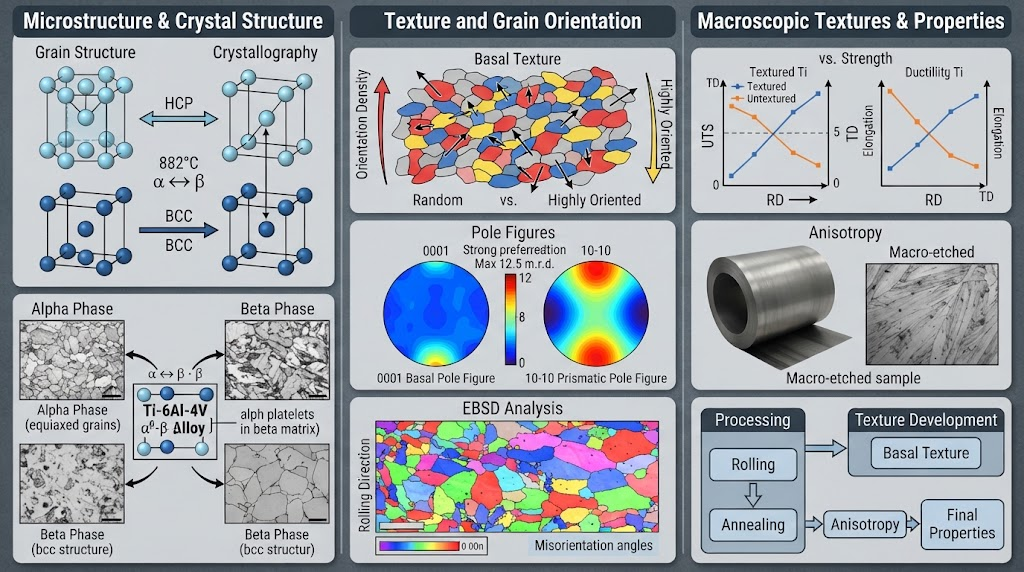
Modern commercial and defense aircraft have shifted standard fluid line baselines from legacy 3,000 psi systems to high-density 4,000 and 5,000 psi architectures. Grade 9 CWSR tubing delivers the requisite hoop strength while keeping wall cross-sections thin.
Hydrostatic containment parameters are calculated using Barlow’s formula, integrating standard aerospace design factors per SAE ARP994 and ISO 6772:
Working Operating Pressure ($P_w$): Operational system load ($\approx \text{Burst Pressure} / 4$).
Proof Pressure ($P_p$): NDT verification threshold without plastic deformation ($1.5 \times P_w$), verified via 100% in-line hydrostatic testing.
Minimum Burst Pressure ($P_b$): $P_b = \frac{2 \cdot S_{\text{ult}} \cdot t_{\text{min}}}{D_o}$ where $S_{\text{ult}}$ is the minimum tensile strength (862 MPa for CWSR), $t_{\text{min}}$ is minimum allowable wall thickness, and $D_o$ is nominal outer diameter.
| Nominal OD (Inches / mm) | Wall Thickness (Inches / mm) | Nominal Weight (kg/m) | Rated Working Pressure ($P_w$) | Factory Proof Pressure ($P_p$) | Calculated Min Burst ($P_b$) |
|---|---|---|---|---|---|
| 0.250" (6.35 mm) | 0.019" (0.48 mm) | 0.039 | 3,000 psi (207 bar) | 4,500 psi (310 bar) | 13,100 psi (903 bar) |
| 0.250" (6.35 mm) | 0.028" (0.71 mm) | 0.056 | 5,000 psi (345 bar) | 7,500 psi (517 bar) | 19,300 psi (1330 bar) |
| 0.375" (9.53 mm) | 0.028" (0.71 mm) | 0.088 | 3,000 psi (207 bar) | 4,500 psi (310 bar) | 12,850 psi (886 bar) |
| 0.375" (9.53 mm) | 0.040" (1.02 mm) | 0.122 | 5,000 psi (345 bar) | 7,500 psi (517 bar) | 18,400 psi (1268 bar) |
| 0.500" (12.70 mm) | 0.038" (0.97 mm) | 0.160 | 3,000 psi (207 bar) | 4,500 psi (310 bar) | 13,100 psi (903 bar) |
| 0.500" (12.70 mm) | 0.052" (1.32 mm) | 0.215 | 5,000 psi (345 bar) | 7,500 psi (517 bar) | 17,900 psi (1234 bar) |
| 0.750" (19.05 mm) | 0.058" (1.47 mm) | 0.363 | 3,000 psi (207 bar) | 4,500 psi (310 bar) | 13,300 psi (917 bar) |
| 1.000" (25.40 mm) | 0.078" (1.98 mm) | 0.651 | 3,000 psi (207 bar) | 4,500 psi (310 bar) | 13,450 psi (927 bar) |
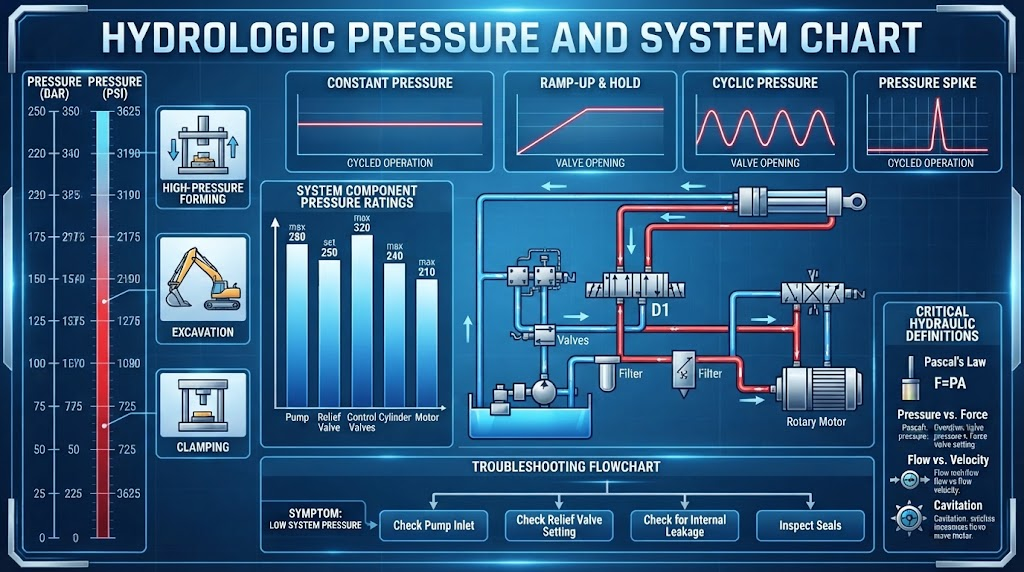
Selecting the optimal alloy for high-pressure lines requires evaluating strength-to-weight efficiency alongside room-temperature ductility and cold formability.
| Property / Metric | Grade 9 CWSR (Ti-3-2.5) | Grade 5 (Ti-6Al-4V) | 316L Stainless Steel | Inconel 625 (UNS N06625) |
|---|---|---|---|---|
| Density ($\text{g/cm}^3$) | 4.48 | 4.43 | 8.00 | 8.44 |
| Weight Savings vs 316L | -44% | -44.6% | Baseline (0%) | +5.5% (Heavier) |
| Yield Strength (MPa) | 724–820 | 880–920 | 220–290 | 415–550 |
| Strength-to-Weight Ratio | 192 | 203 | 36 | 59 |
| Cold Formability / Bendability | Excellent | Very Poor (Requires hot forming) | Excellent | Moderate |
| Seawater Pitting Resistance | Immune (PREN > 45 equivalent) | Immune | Subject to crevice pitting | Highly resistant |
| Typical Aerospace Application | High-pressure hydraulic & fuel lines | Structural brackets, machined fittings | Low-pressure return runs | High-temp engine bleed air |
While Titanium Grade 5 Ti-6Al-4V Seamless Tubes are the standard for high-strength static components, Grade 5 lacks the cold plasticity needed for seamless hydraulic drawing. Its high aluminum content (6%) limits cold dislocations, causing cracking during cold tight-radius bending. Grade 9 solves this with lower aluminum (3%) and vanadium (2.5%), preserving cold formability while delivering more than double the yield strength of 316L stainless.
Modern wide-body and tactical military aircraft utilize Ti-3Al-2.5V hydraulic tubing extensively across primary power distribution networks:
Flight Control Actuation: Direct power feed to primary aileron, rudder, elevator, and wing flap power drive units (PDUs) operating at continuous 3,000 to 5,000 psi impulse cycles.
Landing Gear Retraction: Brake hydraulic lines and shock strut deployment systems subjected to structural deflection and thermal shocks.
Engine Accessory Feeds: High-vibration turbine core fuel delivery and thrust vectoring actuation lines.
In offshore subsea engineering, downhole safety valves (DHSVs) and subsea control umbilicals operate at ocean depths exceeding 3,000 meters (10,000 feet). Grade 9 provides complete immunity to microbiologically influenced corrosion (MIC) and pitting in stagnant seawater, eliminating the stress-corrosion cracking (SCC) vulnerabilities common to super-austenitic steels.
China Titanium Factory supplies Grade 9 tubing compliant with leading OEM specifications, including Boeing BMS 7-234, McDonnell Douglas DMS 2241, Airbus ASNA specifications, and SAE AS5620 interfaces.
Cold rotary draw bending of Grade 9 CWSR requires dedicated tooling to prevent wall collapse, ovality, or inner-radius wrinkling:
Minimum Centerline Bend Radius (CLR): $3 \times D$ (where $D$ is Tube OD) for CWSR; $2 \times D$ for Annealed temper.
Mandrel Configuration: Chrome-plated, multi-ball flexible mandrels paired with bronze-aluminum (Ampco) wiper dies to prevent titanium galling during feed strokes.
Springback Compensation: Grade 9 has an elastic modulus of ~105 GPa, resulting in 1.5 to 2.2 times greater angular springback than austenitic stainless steel. CNC bend programs require overbend compensation algorithms calibrated to specific heat lots.
When flaring for standard flare fitting sleeves, the tube end must be deburred and polished to a surface roughness of $Ra \le 0.4\,\mu\text{m}$ ($16\,\mu\text{in}$). Hardened eccentric rolling cone flaring tools are required. Burnishing the flare face prevents circumferential micro-notches that could propagate into tears during 7,500 psi proof surges.
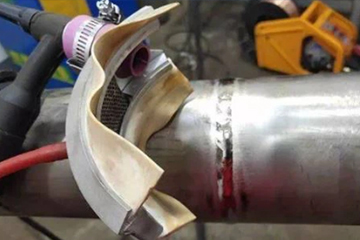
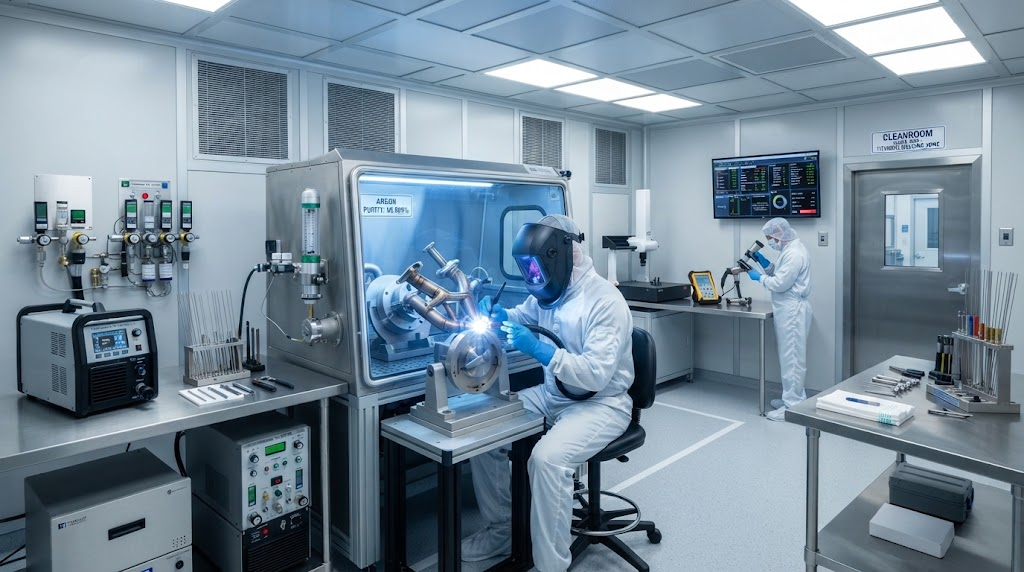
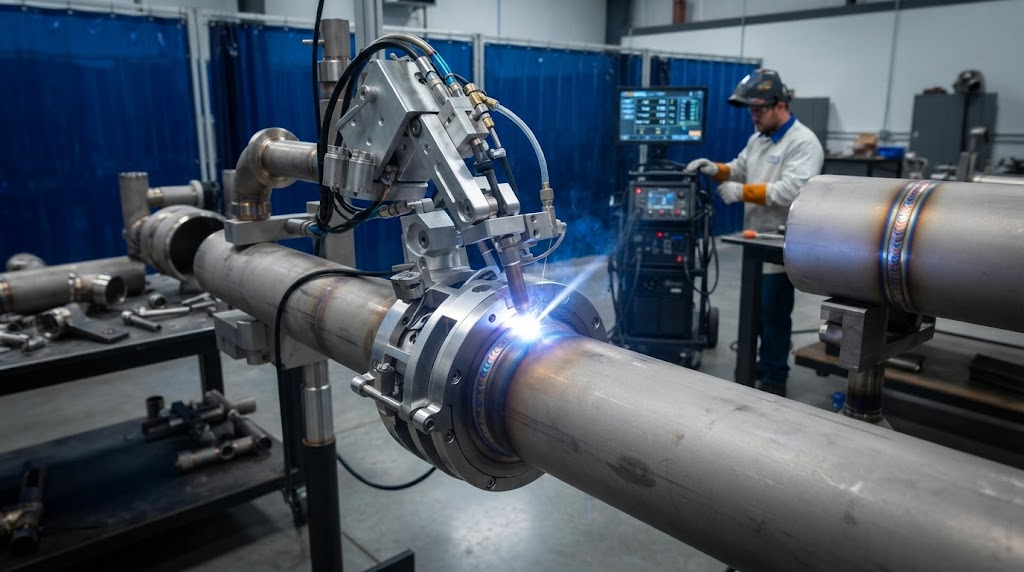
Titanium absorbs atmospheric gases (oxygen, nitrogen, and hydrogen) at temperatures above 800°F (427°C), forming a brittle surface layer called the "alpha case." To ensure clean welds on hydraulic lines:
Shielding Gas: Ultra-high-purity Argon (99.999% purity) with moisture content below -70°F dew point.
Enclosure Purging: Secondary trailing shields on the weld head and 100% internal ID purge until the weld joint cools below 500°F (260°C).
Weld Discoloration Limits: The finished weld must be bright silver. Light straw color is acceptable per AWS D17.1 Class A; blue, purple, or grey oxide discoloration indicates contamination and warrants rejection.
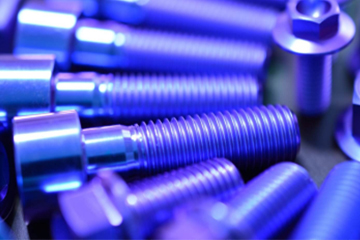
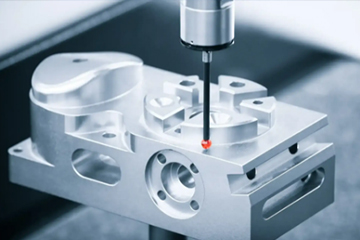
For custom end fittings, flare nuts, and fluid unions, our Precision CNC Titanium Machining division delivers AS9100D-certified mated components with micron-level tolerances.
China Titanium Factory manufactures seamless Grade 9 tubing using our standardized 6-stage HydroPulse™ protocol. This workflow ensures compliance with aerospace specifications such as AMS 4943, AMS 4944, and ASTM B338.
Double/Triple VAR Ingot Conversion: High-purity sponge melting guarantees low interstitial gas levels ($O \le 0.11\%$, $H \le 60\text{ ppm}$).
Multi-Pass Precision Cold Pilgering: Cold reduction schedules with controlled $Q$-ratios maintain radial basal texture (CSR ≥ 1.5).
Ultra-High Vacuum Annealing: Resistance heating below $1 \times 10^{-4}\text{ mbar}$ prevents alpha-case formation and hydrogen pickup.
Dual-Axis Laser Metrology: Continuous OD, wall thickness, and ovality profiling accurate to ±0.025 mm (±0.001 in).
Integrated Dual NDT Testing: 100% in-line Eddy Current inspection per AMS 4943 paired with Multi-Channel Ultrasonic Testing (UT) per AMS 2631/AMS 2634 to detect sub-surface notches down to 0.05 mm (0.002 in).
100% Hydrostatic Proof Testing: Every tube is tested at 1.5× working pressure for a 10-second dwell before final passivation, marking, and packaging.
Every shipment includes an Quality Assurance & NDT Testing Capabilities dossier with EN 10204 3.1 chemical, mechanical, flattening, flaring, and ultrasonic validation records (with EN 10204 3.2 third-party inspection available via DNV, Lloyd's, or SGS).
Procuring factory-direct from China Titanium Factory minimizes intermediary markups while providing custom schedule flexibility for defense programs, subsea infrastructure, and aerospace tier-1 supply chains:
Dimensional Availability: Outer diameters from 0.125 in (3.18 mm) up to 2.000 in (50.8 mm) with wall thicknesses from 0.015 in (0.38 mm) to 0.120 in (3.05 mm).
Flexible Supply Formats: Precision straight lengths up to 15 meters (50 feet) or seamless coiled configurations up to 300 meters for continuous subsea umbilicals.
Packaging Standards: Individual plastic sleeved ends, vapor-corrosion inhibitor (VCI) poly-wrap, and heat-treated export crates (ISPM-15 compliant).
Grade 9 (Ti-3Al-2.5V) is a near-alpha titanium alloy with enough slip systems to allow substantial room-temperature cold work (CWSR) without fracturing. Grade 5 (Ti-6Al-4V) contains 6% aluminum and 4% vanadium, creating an alpha-beta phase balance with limited cold plasticity. Grade 5 requires hot forming at elevated temperatures, making it unsuitable for small-diameter seamless cold drawing, rotary draw bending, or field flaring.
Each production lot includes a certified EN 10204 3.1 Mill Test Certificate containing:
100% Eddy Current Inspection reports per AMS 4943/4944 and ASTM E426.
100% Ultrasonic Testing (UT) reports per AMS 2631 (Class AA/A1) and AMS 2634.
Individual Hydrostatic Proof Pressure test logs.
Flattening (ASTM B338) and 37° Flaring ductility verification test reports.
Chemical ingot and final product assay along with mechanical tensile/yield/elongation data.
Our internal cold-pilger dies and carbide drawing plugs allow us to manufacture custom imperial and metric schedules beyond standard catalogs. We consistently hold outer diameter (OD) and inner diameter (ID) tolerances to ±0.0015 in (±0.038 mm) and wall thickness variation within ±5%, ensuring uniform flow cross-sections and consistent orbital weld profiles.
Access factory-direct pricing, custom dimensional schedules, and complete EN 10204 3.1 certified testing dossiers directly from China Titanium Factory.
Request a Custom Sourcing Quote


Contact Us
Room 21003, 10th Floor, Unit 2, Building 1, Xianning International Plaza, No.29 Xianning West Road, Beilin District, Xi'an City
Copyright © Xi'an Shiguang Jingyan Technology Co., Ltd. All Rights Reserved.