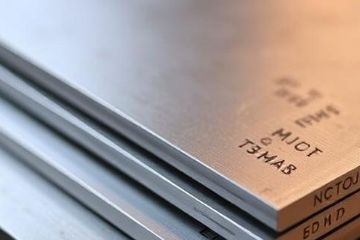
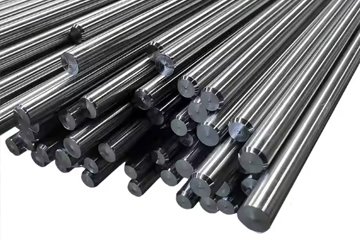
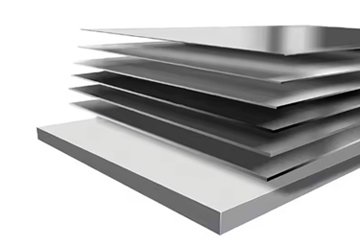
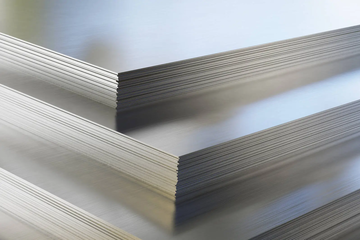
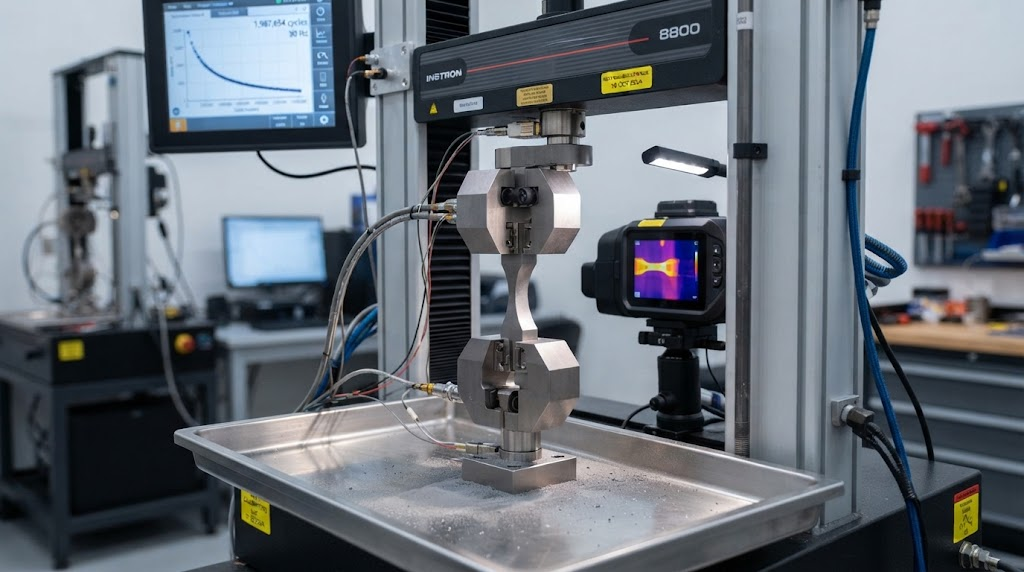
Titanium plate selection requires balancing alloy metallurgy, section thickness limits, surface contamination risks, and raw-material utilization. Choosing the correct plate grade prevents mechanical failure, weld embrittlement, and localized pitting in demanding environments.
When selecting plate material as a procurement engineer or equipment designer, evaluate your operating envelope against four engineering dimensions:
Metallurgical Fit vs. Service Medium: Unalloyed commercially pure (CP) grades (Grade 1, Grade 2) offer superior ductility and resistance to oxidizing acids and chlorides. Alpha-beta alloys like Ti-6Al-4V (Grade 5) and near-alpha alloys like Grade 12 provide high structural tensile ratios at elevated temperatures.
Thickness-Dependent Mechanical Limits: Heavy-gauge plates (thickness t > 2.000 in / 50.8 mm) experience reduced center-line rolling reduction, which lowers yield strength (Rp0.2) by 5% to 8% compared to intermediate plate (0.250 to 1.000 in).
Fabrication Contamination Risk Index: High-temperature exposure during cutting or forming introduces interstitial oxygen and nitrogen, producing brittle alpha-case layers that require post-process chemical milling.
Buy-to-Fly Optimization: Standard mill plates often incur up to 60% scrap rates during nesting. Working with an integrated industrial titanium plate manufacturer enables near-net-shape waterjet cutting and custom width rolling that reduces scrap to under 12%.
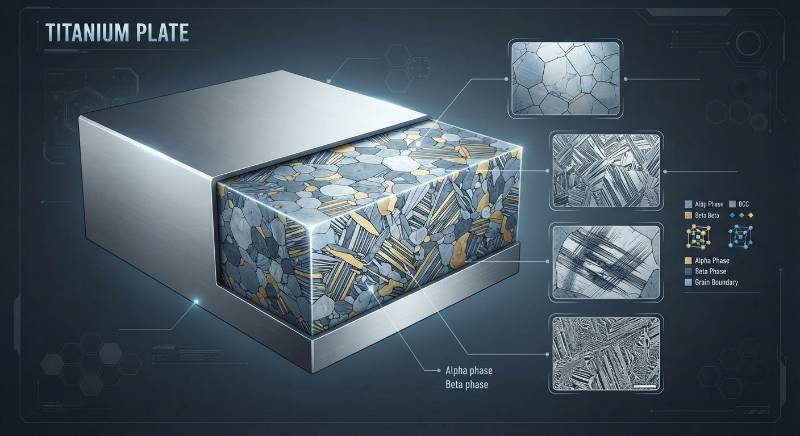
Titanium heavy plate and sheet specifications are governed by three major international standards bodies: ASTM International, ASME, and SAE Aerospace. While chemistry overlapping exists across these specifications, testing protocols and qualification criteria differ significantly.
| Specification | Target Industry | Typical Grades | Key NDT & Quality Mandates |
|---|---|---|---|
| ASTM B265 | Chemical Processing, Marine, Industrial | Gr. 1, 2, 5, 7, 9, 12, 23 | Tensile testing (ASTM E8), guided bend test (ASTM E290), lot-based chemistry. |
| ASME SB-265 | ASME Sec. VIII Boiler & Pressure Vessels | Gr. 1, 2, 3, 7, 12, 16 | Strict maximum allowable stress limits per ASME Section II Part D; mandatory heat traceability. |
| AMS 4911 | Aerospace Structural & Military Airframes | Ti-6Al-4V (Grade 5 Annealed) | Tight oxygen (≤ 0.20%), 100% UT to AMS 2631 Class A/AA, microcleanliness check, strict alpha-case limits. |
| DIN 17860 | European Industrial & Offshore Plant Engineering | 3.7025 (Gr.1), 3.7035 (Gr.2), 3.7165 (Gr.5) | EN 10204 3.1 certification, strict plate dimensional tolerances according to ISO 9227. |
For pressure vessel engineering governed by the ASME Boiler and Pressure Vessel Code (BPVC Section VIII Division 1 & 2), plates must adhere to ASME SB-265. While chemically identical to ASTM B265, SB-265 enforces stricter lot inspection and limits operational design stresses to 25% of the alloy's specified minimum tensile strength (UTS) at design temperature.
Controlling interstitial elements (Oxygen, Nitrogen, Hydrogen, Carbon, and Iron) governs plate ductility and impact toughness. In alpha-beta alloys, slight shifts in oxygen content dramatically alter fracture toughness (KIC).
| Grade | Al | V | Fe | O | C | N | H | Other Elements |
|---|---|---|---|---|---|---|---|---|
| Grade 1 (CP-4) | - | - | 0.20 | 0.18 | 0.08 | 0.03 | 0.015 | Residuals ≤ 0.40 |
| Grade 2 (CP-3) | - | - | 0.30 | 0.25 | 0.08 | 0.03 | 0.015 | Residuals ≤ 0.40 |
| Grade 5 (Ti-6Al-4V) | 5.50 - 6.75 | 3.50 - 4.50 | 0.40 | 0.20 | 0.08 | 0.05 | 0.015 | Residuals ≤ 0.40 |
| Grade 7 (Ti-0.15Pd) | - | - | 0.30 | 0.25 | 0.08 | 0.03 | 0.015 | Pd: 0.12 - 0.25 |
| Grade 12 (Ti-0.3Mo-0.8Ni) | - | - | 0.30 | 0.25 | 0.08 | 0.03 | 0.015 | Mo: 0.2-0.4, Ni: 0.6-0.9 |
| Grade 23 (Ti-6Al-4V ELI) | 5.50 - 6.50 | 3.50 - 4.50 | 0.25 | 0.13 | 0.08 | 0.03 | 0.0125 | Residuals ≤ 0.40 |
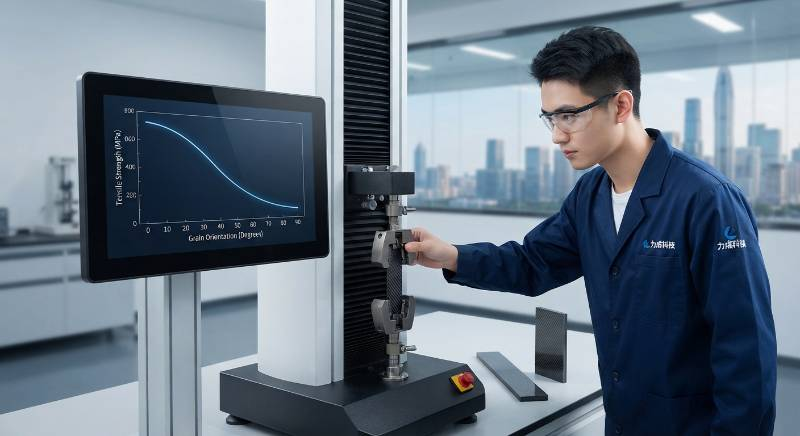
Due to crystallographic texture orientation developed during flat rolling, titanium plates exhibit anisotropic mechanical behavior. Longitudinal (L) specimens yield higher ductility, while Long Transverse (LT) specimens demonstrate 20 to 40 MPa higher tensile strength.
| Grade & Standard | Thickness Range | Test Dir. | Tensile Strength (UTS, MPa) | 0.2% Yield Strength (YS, MPa) | Elongation (% in 2 in / 4D) |
|---|---|---|---|---|---|
| Grade 2 (ASTM B265) | 0.1875 - 1.000 in (4.76 - 25.4 mm) | L / LT | ≥ 345 | 275 - 450 | ≥ 20 |
| 1.001 - 3.000 in (25.4 - 76.2 mm) | L / LT | ≥ 345 | 275 - 450 | ≥ 18 | |
| Grade 5 (Grade 5 Ti-6Al-4V plate specifications) | 0.1875 - 0.750 in (4.76 - 19.05 mm) | LT | ≥ 920 | ≥ 850 | ≥ 10 |
| 0.751 - 2.000 in (19.05 - 50.8 mm) | LT | ≥ 895 | ≥ 825 | ≥ 10 | |
| 2.001 - 4.000 in (50.8 - 101.6 mm) | LT | ≥ 860 | ≥ 790 | ≥ 8 |
Heavy titanium plate production requires tight thermal-mechanical processing (TMP) control to achieve fine, equiaxed microstructure morphologies and prevent center-line porosity.
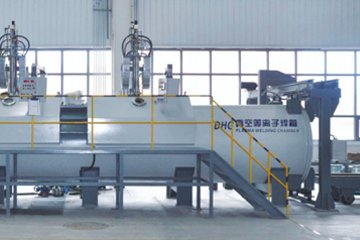
Vacuum Arc Remelting (VAR): Virgin titanium sponge and master alloys (e.g., Al-V eutectic) undergo double or triple VAR melting under 10-2 Pa vacuum to eliminate High-Density Inclusions (HDI) and Low-Density Inclusions (LDI).
Slab Breakdown Forging: Ingot stock is heated in a gas-fired furnace and forged on an open-die hydraulic press above the beta transus (Tβ ≈ 995°C for Ti-6Al-4V) to break down the cast dendritic structure, followed by forging below Tβ to produce a refined lamellar matrix.
Hot Reversible Rolling: Slabs are hot-rolled on a 4-high reversing mill. Rolling passes cross-orient the grain matrix to minimize mechanical anisotropy between the longitudinal (L) and transverse (T) axes. Rolling finishes in the alpha-beta field (900°C - 930°C) to yield globularized alpha phase grains.
Continuous Vacuum Annealing: Plates are heat-treated in horizontal vacuum annealing furnaces at 700°C to 780°C for 1 to 4 hours to relieve internal rolling stresses without forming surface oxide skin.
Chemical Pickling and Descaling: To eliminate thermal diffusion layers, plates pass through an acid pickling bath (15% HNO3 + 3% HF at 45°C to 60°C) to remove the oxidized alpha layer while keeping hydrogen absorption under 125 ppm.
To ensure repeatable performance in subsea extraction, aerospace bulkheads, and corrosive chemical reactors, China Titanium Factory manufactures every plate under our standardized quality process:
Stage 1: Interstitial Chemistry Control: LECO melt analysis tracks gas interstitials across bottom, middle, and top ingot regions to verify oxygen uniformity within ± 0.015%.
Stage 2: Thermomechanical Microstructural Control: Metallographic cross-sections confirm a minimum 60% globular equiaxed alpha phase in an aged transformed beta matrix, preventing coarse Widmanstätten structures.
Stage 3: 100% Ultrasonic Testing (AMS 2631): Immersion and contact pulse-echo ultrasonic scans (per AMS 2631 Class A/AA or ASTM A388) inspect 100% of the plate volume for internal voids, laminations, and micro-cracking down to a 1.2 mm flat-bottom hole equivalent.
Stage 4: Surface Planarity and Metrology: Roller flattening achieves plate flatness ≤ 1.5 mm per linear meter, supported by laser thickness verification to ASTM B265 Table 6 tolerances.
Titanium plate fabrication requires cutting techniques that mitigate thermal distortion and alpha-case embrittlement. Low thermal conductivity (6.7 W/m·K for Grade 5) causes rapid heat buildup at the tool tip during CNC operations.
Abrasive Waterjet Cutting (AWJ): The industry benchmark for profiling titanium plate up to 150 mm thick. Operating at 60,000 to 90,000 psi with 80-mesh garnet abrasive, AWJ leaves a zero-heat-affected zone (0.00 mm HAZ) and produces no alpha-case layer.
Fiber Laser Cutting: Effective for thin plate (t ≤ 6.0 mm). High-purity argon assist gas (99.999%) is mandatory to avoid oxidation. Air or nitrogen assist gases yield a brittle, nitrided cut edge that must be ground back by at least 0.5 mm.
High-Speed Saw Cutting: Heavy carbide-tipped bandsaws running at 15 to 25 m/min with flood synthetic coolant are used to section heavy billets without causing microstructural changes.
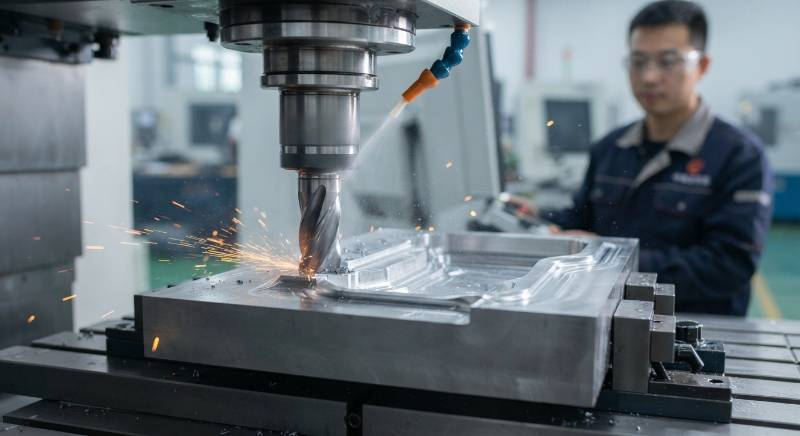
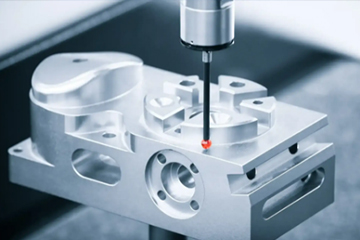
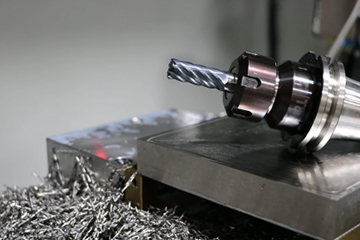
Machining thick plate sections requires rigid fixturing to eliminate chatter and avoid work hardening. For detailed machining configurations, explore our custom titanium CNC machining services.
| Operation | Tooling / Substrate | Cutting Speed (Vc, m/min) | Feed per Tooth (fz, mm/z) | Coolant Requirement |
|---|---|---|---|---|
| Face Milling (Roughing) | Micro-grain Carbide + TiAlN/AlTiN PVD | 40 - 55 | 0.12 - 0.20 | Flood EP emulsion (8-10% conc.), 20 bar |
| Face Milling (Finishing) | Polished Uncoated / AlCrN PVD Carbide | 60 - 80 | 0.08 - 0.12 | High-pressure through-spindle (70+ bar) |
| Deep Cavity Pocketing | Solid Carbide Variable Helix (38°/41°) | 45 - 65 | 0.05 - 0.10 | High-pressure through-tool coolant |
| Heavy Drilling (Holemaking) | Solid Carbide Drill + 140° split point | 25 - 40 | 0.06 - 0.15 mm/rev | Through-tool coolant (min 40 bar) |
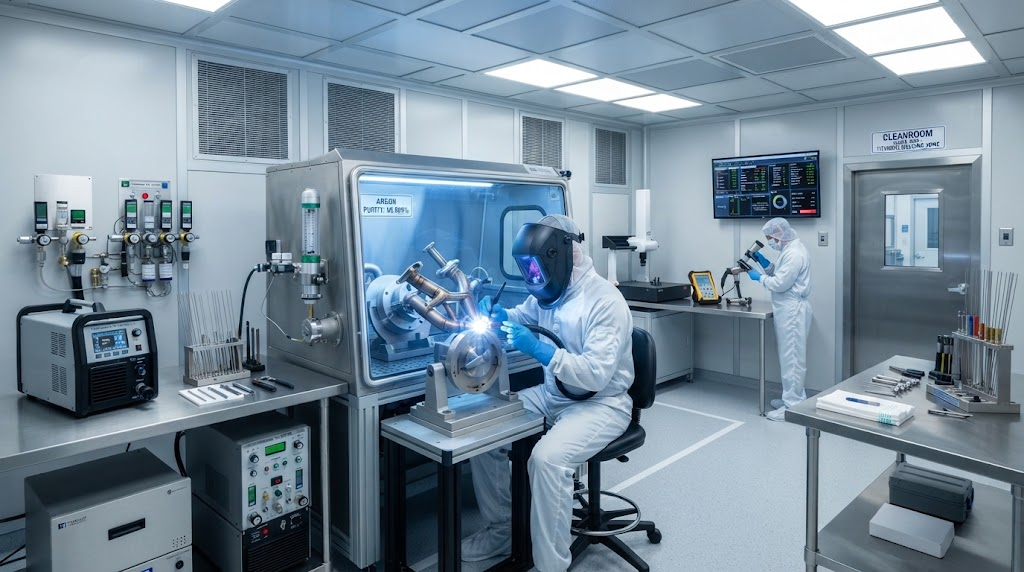
Titanium absorbs atmospheric gases above 425°C. Fabricating structural plates requires complete inert shielding across the molten pool, trailing zone, and weld root backside.
Shielding Gas Purity: Use AWS A5.32 Grade SG-A argon (99.999% purity, dewpoint ≤ -65°C).
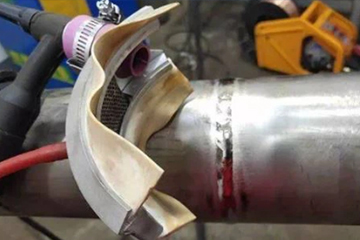
Trailing Shield Design: Equip welding torches with secondary trailing shoe diffusers extending at least 100 mm behind the arc. Supply purge backing channels with argon at 10 to 20 L/min.
Weld Color Acceptance: Acceptable welds display bright silver or light straw tints. Dark straw or peacock coloration requires mechanical removal. Gray, powdery, or white crust formation indicates critical oxygen uptake, requiring weld rejection and re-jointing.
Cold forming titanium plates requires conditioning edge profiles by deburring, radiusing, and polishing to remove notch sensitivity along the outer bend radius.
| Titanium Grade | Thickness ≤ 1.8 mm (0.070 in) | Thickness 1.8 mm to 4.76 mm | Thickness > 4.76 mm (Heavy Plate) |
|---|---|---|---|
| Grade 1 | 1.5t | 1.5t | 2.0t |
| Grade 2 | 2.0t | 2.0t | 2.5t |
| Grade 5 (Ti-6Al-4V) | 4.5t | 5.0t | Hot forming recommended (> 550°C) |
To relieve residual stresses following welding or cold forming, apply vacuum stress relief heat treatments:
Grade 2 CP Titanium: 540°C ± 15°C for 30 to 60 minutes; air cool in clean air or argon purge.
Grade 5 (Ti-6Al-4V): 600°C to 650°C for 1 to 2 hours under vacuum (< 10-3 Pa) to prevent alpha-case formation; furnace cool below 350°C.
Titanium plate provides high strength-to-weight ratios and chloride resistance across challenging operating environments:
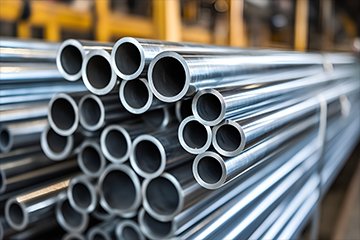
ASME Section VIII Pressure Vessel Tube Sheets: Ultra-heavy Grade 2, 7, and 12 plates (up to 120 mm thick) serve as reactor tubesheets in PTA (Purified Terephthalic Acid) plants and desalination plants. Their low coefficient of thermal expansion (8.6 × 10⁻⁶/K) minimizes thermal fatigue against titanium heat exchanger tubes.
Explosion-Bonded Clad Plates for Heavy Chemical Vessels: For high-pressure, high-volume autoclave reactors, solid titanium plate can be cost-prohibitive. Using explosion bonded titanium clad steel plates (e.g., 3 to 10 mm Grade 1/2 titanium bonded to 30 to 90 mm SA516 Gr. 70 carbon steel per ASTM B898) provides identical corrosion protection while cutting raw material costs by up to 50%.
Aerospace Wing Skins & Bulkheads: AMS 4911 Grade 5 plate is machined into structural airframe frames, wing ribs, and landing gear bulkheads, maintaining fatigue resistance up to 350°C.
Naval Armor & Marine Hull Structures: Thick Grade 5 ELI plates provide ballistic protection and cavitation erosion resistance for deep-submergence pressure hulls.
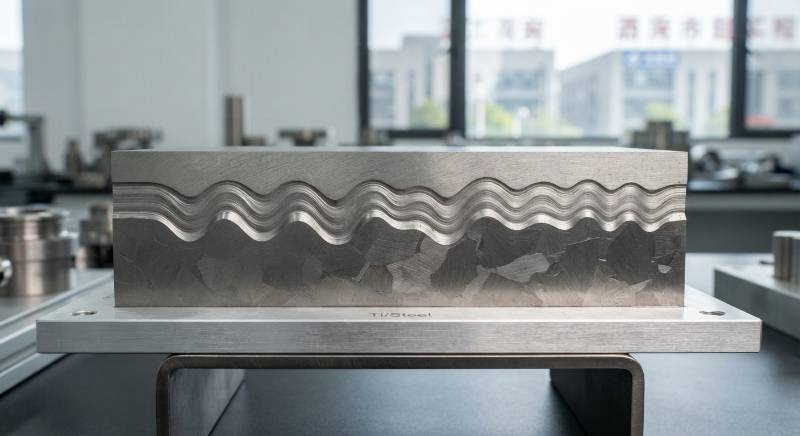
Every structural titanium plate should arrive with an authentic, legally binding EN 10204 3.1 Mill Test Certificate traceable to the original melting heat. Use this auditing sequence during incoming receiving inspection:
Melt Source & Melting Method: Verify that the primary ingot was produced via Vacuum Arc Remelting (VAR) or Electron Beam Cold Hearth Melting (EBCHM). Multi-melt records must note individual melt numbers.
Interstitial Chemical Boundaries: Confirm that LECO analysis covers all elements: C, N, H, O, and Fe. Ensure Hydrogen levels are strictly ≤ 0.0125% (125 ppm) to rule out hydrogen embrittlement.
Specimen Test Orientation (L vs. LT): Check that mechanical properties note test orientation. Long Transverse (LT) values are mandatory for aerospace AMS 4911 compliance.
Ultrasonic NDT Statement: Verify the non-destructive testing method reference (e.g., "AMS 2631 Class A" or "ASTM A388/A388M") along with confirmation of zero unrecorded defect signals.
Heat Number Stamping Traceability: Match the physically hard-stamped, vibro-etched, or dot-peened heat number and plate ID on the edge of the titanium plate with the certificate header.
ASTM B265 targets general industrial, chemical, and marine applications where yield strength and corrosion resistance are primary drivers. AMS 4911 is an aerospace material specification enforcing tighter oxygen content (≤ 0.20%), mandatory transverse bend tests, alpha-case surface inspection, and 100% volumetric ultrasonic inspection per AMS 2631 Class A/AA.
Alpha-case is best avoided by using cold abrasive waterjet (AWJ) cutting, which generates zero heat-affected zone. If plasma or oxy-assisted laser cutting is used, you must mechanically grind or chemically pickle the plate edge to remove at least 1.0 to 1.5 mm of subsurface material where oxygen diffusion occurred.
Titanium plate tolerances are governed by ASTM B265 Table 6. For example, a hot-rolled plate with a nominal thickness between 0.500 in (12.7 mm) and 0.750 in (19.05 mm) spanning over 60 inches in width maintains a permissible thickness variation of ± 0.040 in (± 1.02 mm).
Procuring certified titanium plate blanks from China Titanium Factory follows a streamlined engineering workflow:
Upload your CAD files (DXF, STEP, or PDF) detailing plate grade, final dimensions, thickness tolerances, and specification requirements (ASTM B265, ASME SB-265, or AMS 4911).
Our metallurgical team conducts a design-for-manufacturing review, utilizing dynamic multi-part nesting across custom-width rolled plates to minimize scrap and maximize yield.
Receive comprehensive manufacturing tracking, EN 10204 3.1 MTC certificates, ultrasonic test records, and rapid export dispatch direct from our manufacturing facility.
Speak directly with our senior metallurgical team for technical evaluations, custom rolling inquiries, and rapid quoting.
Request an Engineering Quote


Contact Us
Room 21003, 10th Floor, Unit 2, Building 1, Xianning International Plaza, No.29 Xianning West Road, Beilin District, Xi'an City
Copyright © Xi'an Shiguang Jingyan Technology Co., Ltd. All Rights Reserved.