





















Fundamentals of Titanium Color Anodization: Thin-Film Interference & Bragg's Law
Titanium anodizing colors are produced without dyes, pigments, or chemical colorants. The perceptible chromatic palette is generated entirely through controlled electrochemical growth of a transparent titanium dioxide (TiO2) barrier layer that manipulates ambient light via thin-film optical interference governed by Bragg's Law.
When incidental white light strikes an anodized titanium component, the incoming photon stream splits at the boundary interface. A fraction of the light wave reflects off the exterior surface of the TiO2 oxide film (Boundary 1), while the remaining wave refracts into the oxide layer (refractive index n ≈ 2.5 for amorphous-to-anatase TiO2) and reflects off the underlying metallic titanium substrate (Boundary 2).
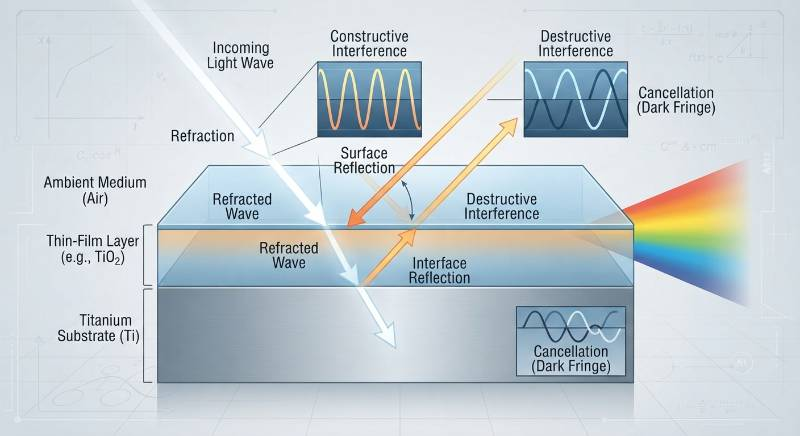
As the refracted light wave exits the titanium dioxide layer, it exhibits a physical phase displacement relative to the wave reflected from Boundary 1. Depending on the precise physical thickness (d) of the oxide layer and the angle of refraction (θ), specific light wavelengths undergo constructive interference (reinforcing visual intensity) while opposing wavelengths undergo destructive interference (canceling out completely).
Constructive Waveform Equation: 2 · n · d · cos(θ) = (m + 1/2) · λ
Where n is the refractive index of the TiO2 film (≈ 2.50), d is oxide thickness in nanometers, m is the integer order of interference (0, 1, 2), and λ is the intensified visual wavelength.
Because the generated colors depend purely on nanometer-scale film geometry, the final visual hue serves as an exact optical signature of oxide thickness. China Titanium Factory implements this physical principle across advanced chemical processing lines to achieve micron-level repeatability without compromising base material tolerances.
Electrochemical Process Mechanics: Electrolyte Chemistry, Cathodes, and Voltage Growth Rates
The electrochemical anodization of titanium is an electrolytic cell reaction where the titanium component serves as the positive anode (immersed in an aqueous electrolyte) and an inert conductive material functions as the cathode. When a direct current (DC) potential is applied, water molecules hydrolyze at the anode surface:
Anodic Oxidation Reaction: Ti + 2H2O → TiO2 + 4H+ + 4e-
As oxygen ions migrate inward under the applied electric field, an amorphous barrier layer of titanium dioxide forms uniformly over the component. This dielectric oxide layer exhibits high electrical resistivity, progressively choking the electrical current flow until an equilibrium thickness is established for that specific applied voltage.
Electrolyte Chemistry and Cathode Configuration
Industrial anodizing systems utilize distinct electrolyte chemistries depending on cleanroom parameters and component utility:
Trisodium Phosphate (TSP - Na3PO4): Concentrations of 3% to 5% by weight in deionized (DI) water provide an optimal mild alkaline bath (pH 9-11) yielding clean, saturated optical colors without substrate micro-pitting.
Citric Acid (C6H8O7): Used heavily for biocompatible medical device indexing per ASTM F86 standard practices, ensuring zero hazardous residues.
Dilute Sulfuric Acid (H2SO4): 1% to 3% concentration baths deliver rapid dielectric response, though they demand tighter temperature moderation (18°C–22°C) to prevent local dielectric breakdown.
China Titanium Factory exclusively utilizes high-purity Grade 1 / Grade 2 titanium plates or 316L stainless steel panels as cathodes. Cathode-to-anode surface area ratios are strictly maintained at a minimum of 2:1 to prevent cathode polarization, ensuring stable current density between 0.5 A/dm2 and 1.5 A/dm2 across entire production batches.
Dielectric Growth Kinetics: The 1.6 to 2.0 nm/V Constant
In our precision chemical processing facilities, titanium dioxide film growth adheres to a linear physical constant of 1.6 nm to 2.0 nm per applied Volt (DC). A direct application of 20V generates an oxide layer measuring approximately 36 nm to 40 nm, while 100V builds an oxide barrier exceeding 180 nm.
Because the chemical reaction converts existing substrate surface titanium atoms rather than adding external material, the physical dimensional change of the finished component is functionally zero (sub-micron scale). This ensures that critical thread leads, ground bearing journals, and precision aerospace tolerances produced via our precision CNC titanium machining services remain fully within specification without post-process finishing adjustments.
The Definitive 0V to 120V DC Titanium Anodizing Voltage & Color Spectrum Chart
The operational chart below maps precise DC voltage inputs to dielectric oxide thickness, optical interference wavelength, and chromatic output across chemically etched Commercially Pure (CP Grade 2) and Alpha-Beta structural alloys.
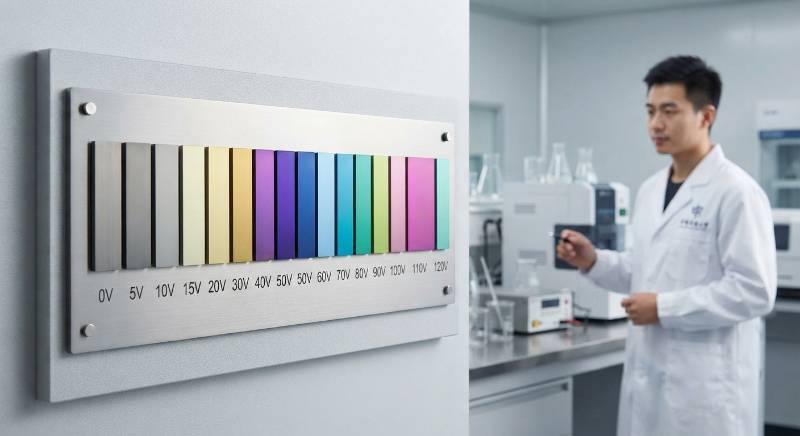
| Applied Voltage (V DC) | TiO2 Thickness (nm) | Interference Order | Resulting Hue / Appearance | Industrial & Engineering Application |
|---|---|---|---|---|
| 0V – 5V | 5 – 10 nm | Native Layer | Natural Silver / Gray | Standard mill finish, unpassivated raw substrate |
| 12V – 15V | 22 – 28 nm | 1st Order | Warm Bronze / Pale Champagne | Orthopedic bone plate indexing, dental abutments |
| 18V – 22V | 32 – 40 nm | 1st Order | Deep Violet / Dark Purple | Surgical instrument marking, high-end motorsport fasteners |
| 25V – 30V | 45 – 55 nm | 1st Order | Royal Blue / Deep Navy | Aviation hydraulic line routing, cryogenic valve hardware |
| 35V – 42V | 60 – 75 nm | 1st Order | Electric Cyan / Ice Blue | Marine structural connectors, high-durability color coding |
| 48V – 55V | 85 – 100 nm | 1st Order | Light Straw / Bright Gold | Aerospace fastener identification per AMS 2486 |
| 58V – 65V | 105 – 120 nm | 1st Order | Amber Rose / Salmon Pink | Precision consumer hardware, robotic arm articulation tags |
| 70V – 78V | 125 – 140 nm | 2nd Order | Vibrant Magenta / Orchid | Medical surgical drill guides, aerospace instrumentation |
| 82V – 90V | 150 – 165 nm | 2nd Order | Teal / Emerald Green | Spinal implant screw sizing, defense sub-assembly routing |
| 95V – 110V | 175 – 210 nm | 2nd Order | Electric Lime / Apple Green | High-voltage precision medical assemblies, EDC components |
| 115V+ | > 220 nm | Dielectric Limit | Faded Pink / White Chalk (Dielectric breakdown) | Non-functional; bath arcing and local oxide destruction |
Low Voltage Spectrum (12V – 25V): Bronze, Brown, and Dark Purple
First-order interference begins at 12V. Between 12V and 25V, the oxide layer measures only 20 nm to 45 nm. Because this layer is extremely thin, it exhibits subtle light refraction, yielding rich earth tones, champagne bronze, and deep purples.
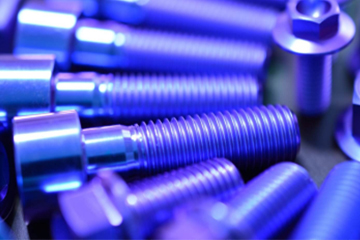
These thin films are highly wear-sensitive. For applications demanding continuous friction resistance, such as custom anodized titanium fasteners used in critical subsea or motorsport joints, we apply specific mechanical polishing protocols prior to low-voltage conversion to ensure uniform light scatter and maximized surface hardness.
Mid Voltage Spectrum (30V – 65V): Electric Blue, Sky Blue, and Golden Yellow
The 30V to 65V window represents the most stable and repeatable operational regime in commercial titanium processing. Oxide thickness spans 55 nm to 120 nm, generating vibrant first-order electric blues, pale cyans, and rich metallic golds.
Mid-voltage layers provide excellent chemical stability and are impervious to handling with bare skin. China Titanium Factory runs automated PLC voltage ramping within this zone (ramping at 1.5 V/sec) to ensure total color uniformity across complex 5-axis geometries.
High Voltage Spectrum (70V – 110V+): Pink, Magenta, Teal, and High-Voltage Green
Beyond 70V, the oxide layer enters second-order optical interference, traversing 130 nm to over 200 nm. Second-order wavelengths produce striking magentas, purplish pinks, and highly sought-after emerald and lime greens.
High-voltage anodizing requires industrial-grade rectifiers equipped with fast-acting solid-state overcurrent protection. Exceeding 110V–115V without precise current limiting triggers dielectric breakdown (spark anodization), causing thermal oxide cracking and chalky white surface degradation.
Substrate Metallurgy & Grade-Specific Voltage Shift (CP Grade 2 vs. Ti-6Al-4V Grade 5 & Grade 23 ELI)
A frequent failure mode in industrial titanium finishing is the assumption that a single voltage produces identical color across all titanium alloys. Substrate chemical composition and phase structure drastically alter electrical resistivity and oxide growth dynamics.
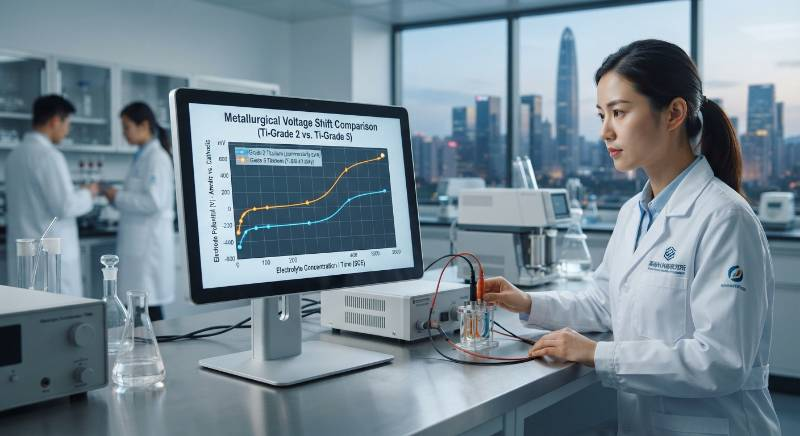
When transitioning from Commercially Pure Grade 2 (ASTM F67 / ASTM B348) to dual-phase Alpha-Beta Grade 5 Ti-6Al-4V titanium alloy (ASTM B348 / AMS 4928) or medical Grade 23 Ti-6Al-4V ELI (ASTM F136), process engineers must integrate a mandatory +3V to +8V positive voltage shift offset.
Empirical Voltage Compensation Formulation:
VTarget(Gr5) = VBase(Gr2) + ΔVAlloy
Where ΔVAlloy ranges from +3.5V (in the 15V-40V regime) to +8.0V (in the 80V-105V regime).
This metallurgical voltage offset is driven by two specific elemental mechanisms:
Aluminum (6% Al): Aluminum acts as an Alpha-phase stabilizer and builds a highly resistive Al2O3 component within the mixed oxide matrix, increasing dielectric barrier impedance.
Vanadium (4% V): Vanadium acts as a Beta-phase stabilizer, segregating into distinct intergranular boundaries that alter localized current density and require elevated potential to achieve equivalent phase retardation.
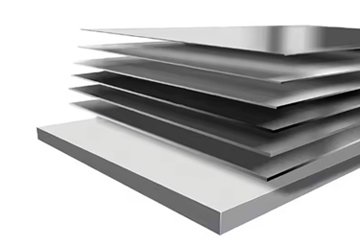
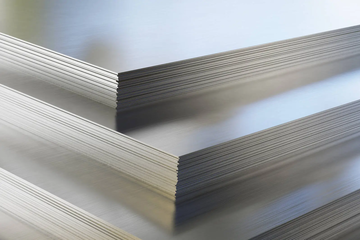
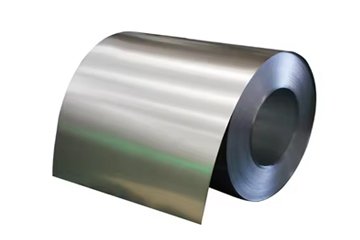
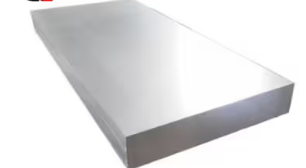
Furthermore, structural stock forms such as rolled ASTM B265 titanium sheet and plate exhibit directional rolling grain structures that mandate calibrated pre-treatment chemical etching to eliminate color blotching and yield uniform CIELAB chromaticity.
Physical Boundaries of Type III Anodizing: Why True Red and True Black Do Not Exist
Procurement specifications frequently request "Fire Engine Red" or "Jet Black" Type III anodized titanium. In production metallurgy, achieving these specific hues via Type III electrochemical interference is physically impossible.
Why Primary Red Cannot Be Formed
For a surface to appear pure primary red (wavelength ≈ 650–700 nm), the oxide layer must completely cancel out all shorter wavelengths (violet, blue, green, and yellow) through destructive interference while constructively reinforcing red light alone.
Due to the high refractive index of titanium dioxide (n ≈ 2.5) across the visible spectrum, constructive interference in the red wavelength spectrum always overlaps with secondary harmonic reflections in the blue and violet bands. As a result, high-voltage red passes directly into magenta, orchid pink, or bronze-rose, never resolving into pure spectral red.
Why Type III Cannot Produce Black
True black requires total, broadband optical absorption across all visible wavelengths (400 nm to 750 nm). Because titanium dioxide is a wide bandgap semiconductor (Eg ≈ 3.0–3.2 eV) that is optically transparent in thin-film geometries, it cannot absorb visible photons.
To achieve high-performance black titanium components, China Titanium Factory deploys two industrial alternative processes:
Physical Vapor Deposition (PVD / DLC): Sputtering Titanium Aluminum Nitride (TiAlN) or Diamond-Like Carbon (DLC) creates an ultra-hard (2500–3500 HV), wear-resistant deep black coating (1.5–3.0 μm) without sacrificing dimensional accuracy.
Plasma Electrolytic Oxidation (PEO / MAO): High-voltage micro-arc discharge in specialized alkaline electrolytes forms a thick (10–50 μm), porous ceramic conversion layer enriched with black transition metal oxides for maximum thermal and dielectric insulation.
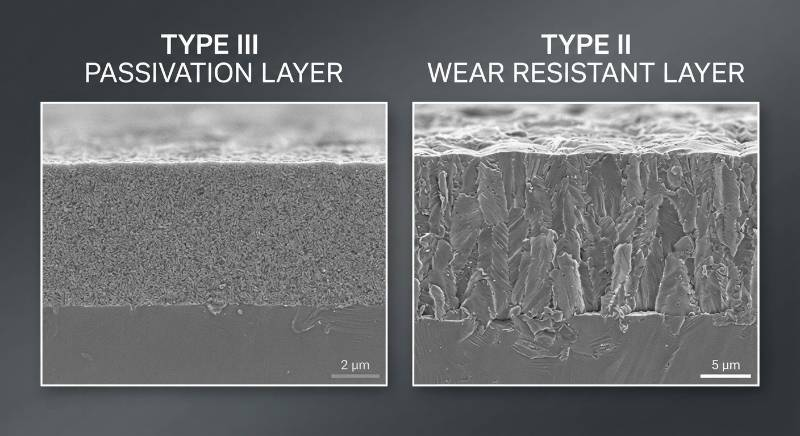
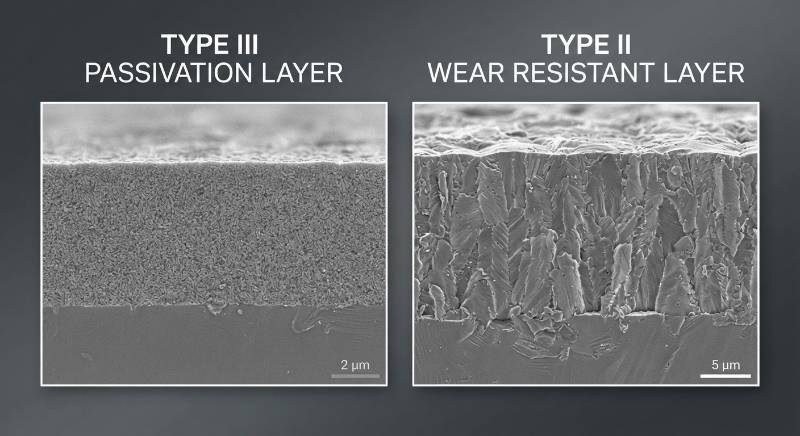
Process Selection Guide: Type III Color Passivation vs. Type II Anti-Galling vs. PVD
Selecting the correct surface specification depends on mechanical friction, operating environment, and regulatory standards. The matrix below compares the three predominant industrial titanium finishing methods.
| Engineering Parameter | Type III Color Anodizing | Type II Anti-Galling Anodizing | PVD / DLC Hard Coatings |
|---|---|---|---|
| Governing Specifications | AMS 2486, ASTM F86, ISO 13485 | AMS 2488D, MIL-A-8625 (Ref) | AMS 2444, OEM Proprietary Specs |
| Primary Function | Color indexing, passivation, biocompatibility | Wear resistance, galling prevention, lubrication keying | Extreme wear resistance, true black/gold aesthetics |
| Layer Thickness | 10 nm – 250 nm (0.01 – 0.25 μm) | 1.0 μm – 5.0 μm | 1.5 μm – 4.0 μm |
| Dimensional Impact | 0.000 mm (Zero dimensional variance) | +1.0 to +3.0 μm growth per side | +1.5 to +4.0 μm growth per surface |
| Color Availability | Full spectrum (Bronze, Blue, Gold, Magenta, Green) | Dull matte gray / charcoal only | True Black, TiN Gold, Rose Gold, Chrome Silver |
| Biocompatibility | 100% Biocompatible (ISO 10993 certified) | Biocompatible (Application specific) | High (Requires substrate pre-cleaning validation) |
| Friction Coefficient (μ) | 0.35 – 0.45 (Standard titanium baseline) | 0.12 – 0.20 (With dry-film lubricant) | 0.08 – 0.15 (Ultra-low friction DLC) |
Industrial Applications: Medical Device Indexing, Aerospace Fasteners, and Precision EDC Hardware
Medical Device and Surgical Implant Indexing
In surgical environments, misidentifying screw lengths or plate diameters can lead to severe surgical delays. Under ISO 13485 manufacturing protocols, China Titanium Factory produces color-coded Ti-6Al-4V ELI (Grade 23) orthopedic bone screws, spinal fixation rods, and trauma plates.
Because Type III anodizing uses zero pigments or toxic chemistry, it meets strict ISO 10993 cytotoxicity and hemocompatibility standards while providing immediate visual recognition for surgical staff.
Aerospace Assemblies and AS9100 Fastener Systems
In commercial and defense aerospace structures, AMS 2486 Type III color coding is utilized across fuel line routing connectors, pneumatic fittings, and high-strength threaded fasteners. Standardized colors differentiate left-hand from right-hand threads, metric from imperial fasteners, and specific torque ratings across airframe assemblies.
Subsea Connectors and High-Performance EDC Hardware
Due to the superior chloride ion resistance of passivated titanium dioxide, anodized marine sensors and subsea instrumentation housings withstand multi-year salt spray exposure without pitting. In consumer hardware, knife frames, flashlight bodies, and luxury watch cases leverage clean spectrum anodization to deliver durable metallic finishes that will not chip, peel, or flake.
The China Titanium Factory Optical Passivation Protocol (CTF-OPP)
Achieving batch-to-batch color consistency requires systematic control over chemical etching, bath conductivity, temperature, and voltage dwell times. China Titanium Factory executes all color finishing through our validated 4-phase protocol:
Phase 1: Multi-Stage Chemical Pre-Treatment & Etch: Components undergo ultrasonic degreasing in non-chlorinated solvent, followed by a controlled 10-to-20-second immersion in a nitric-hydrofluoric acid bath (HNO3/HF at a 10:1 ratio per ASTM A380). This strips irregular native air-formed oxides, removing surface alpha-case layers and establishing a uniform 0.4–0.8 μm Ra micro-roughness foundation.
Phase 2: Closed-Loop Micro-Voltage Rectification: Components are secured to custom pure Grade 2 titanium racks with pressurized contact points (eliminating contact resistance burns). The electrolytic bath is regulated with ±0.1V precision using solid-state IGBT switch-mode rectifiers running automated software-controlled voltage curves.
Phase 3: Substrate Grade-Indexed Dwell Calibration: Bath temperature is continuously chilled and circulated at 20°C (±1°C) to prevent thermal boundary dissipation. Applied voltage is held for a calibrated dwell time (30 to 60 seconds) until electrical current density drops to baseline passivation thresholds (≤ 0.05 A/dm2), confirming complete dielectric barrier formation.
Phase 4: Multi-Stage Deionized Cascade Passivation: Immediately following anodic growth, components pass through a 3-stage counter-current cascade rinse using deionized water (resistivity > 10 MΩ·cm) and dry under filtered heated nitrogen air at 65°C, ensuring a pristine, residue-free surface.
Quality Assurance: Spectrophotometric CIELAB Verification, Adhesion Testing, and Biocompatibility
To eliminate subjective visual inspection errors, China Titanium Factory verifies all anodized production lots using precise quantitative metrology protocols.
| Quality Parameter | Verification Standard | Pass / Fail Acceptance Criteria | Documentation Provided |
|---|---|---|---|
| Color Repeatability | CIELAB Color Metrology (D65 Illuminant, 10° Observer) | ΔE*ab < 1.0 (Imperceptible to the human eye across production lots) | Spectrophotometer Spectral Trace Report |
| Oxide Layer Adhesion | ASTM D3359 Method B (Cross-Hatch Tape Adhesion) | Classification 5B (0% flaking or detachment along cross-cuts) | Mechanical Test Certificate |
| Passivation Integrity | ASTM F86 / ASTM A967 (Copper Sulfate & Humidity Testing) | Zero copper plating; zero corrosion spots after 48-hr humidity exposure | Passivation Compliance Inspection Report |
| Material Traceability | EN 10204 Type 3.1 & 3.2 Inspection Certificates | 100% dual-melt vacuum arc remelted (VAR) chemical traceability | Certified Mill Test Certificate (MTC) |
Frequently Asked Questions About Titanium Anodizing Colors
Does titanium color anodizing fade or rub off over time?
Titanium color anodizing does not degrade or fade from UV light exposure because it contains no organic dyes. However, because Type III films measure only 20 nm to 200 nm in thickness, continuous mechanical abrasion will wear away the oxide layer down to the bare silver substrate.
Additionally, skin oils from fingerprints can temporarily alter the surface refractive index, making the color appear dull or shifted. Cleaning the component with isopropyl alcohol or mild detergent instantly restores the original optical hue.
Can welded titanium assemblies be uniformly color anodized?
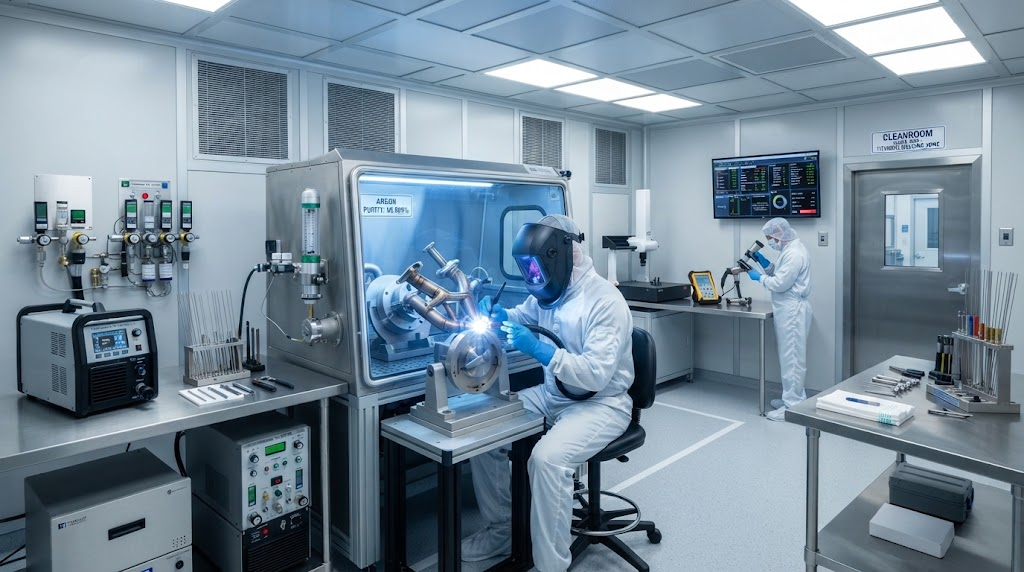
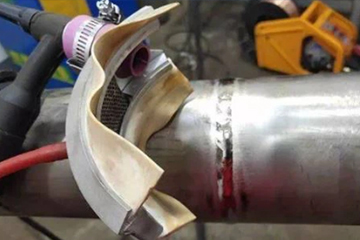
Yes, provided the welding process was conducted under complete inert gas shielding (trailing shield with pure argon). If atmospheric oxygen or nitrogen contaminated the weld zone, the altered heat-affected zone (HAZ) metallurgy will create local electrical resistance changes, resulting in distinct color banding across the weld bead.
Does Type III anodizing alter precision CNC machining tolerances?
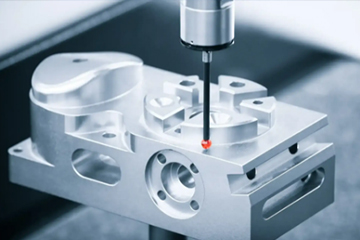
No. Type III anodizing converts existing surface titanium into an oxide layer measuring under 0.25 μm (0.00025 mm). This dimensional change is well within standard CNC grinding, turning, and milling tolerances, making it fully safe for high-precision aerospace threads, optical alignment housings, and medical implants.
Initiate Custom Anodized Titanium Component Production: 3-Step Action Pathway
China Titanium Factory delivers end-to-end titanium manufacturing, spanning certified raw material production, 5-axis precision CNC machining, and automated optical anodization.
Your Seamless Path to Precision Finished Titanium Parts
Step 1: Submit Drawing & Spectral Requirements: Upload your 2D/3D CAD models (STEP, IGES, or PDF) via our secure engineering portal, specifying your base alloy grade, target color spectrum, or AMS/ASTM standard requirements.
Step 2: 4-Hour DFM & Voltage Calibration Review: Our senior metallurgists complete a comprehensive Design for Manufacturability (DFM) review, delivering a precise voltage-calibration matrix and competitive factory-direct pricing.
Step 3: Rapid Prototyping & Scaled Production: Receive functional, color-matched prototype samples within 48 hours complete with certified EN 10204 3.1 MTCs, before scaling into full AS9100 and ISO 13485 volume manufacturing.