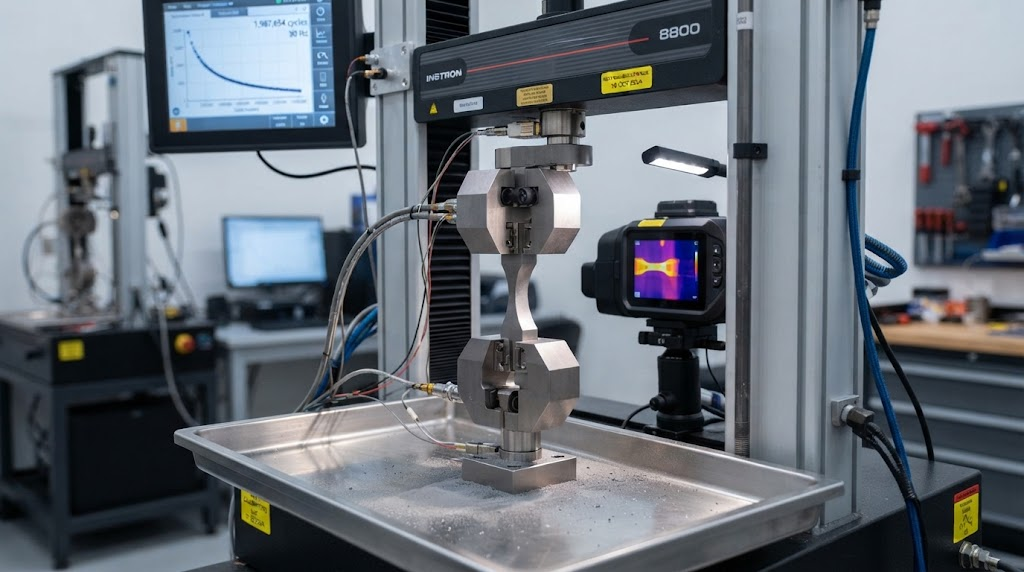
An anode rod prevents a water heater’s carbon steel tank from corroding by providing cathodic protection, acting as a sacrificial electron donor or a powered current emitter. By maintaining a more negative electrochemical potential than the steel vessel, the rod forces oxidation to occur exclusively at its own surface, preventing structural tank wall breach and catastrophic leaks.
Inside a standard water heater, water acts as an electrolyte. When water contacts microscopic cracks in the inner glass or porcelain lining, it establishes a natural galvanic circuit with the raw steel backing.
Without an active anode rod, oxygen and dissolved minerals strip electrons directly from the iron structure ($Fe \rightarrow Fe^{2+} + 2e^-$). The presence of an active anode alters this circuit, polarizing the steel and rendering it the non-corroding cathode of the electrochemical cell.
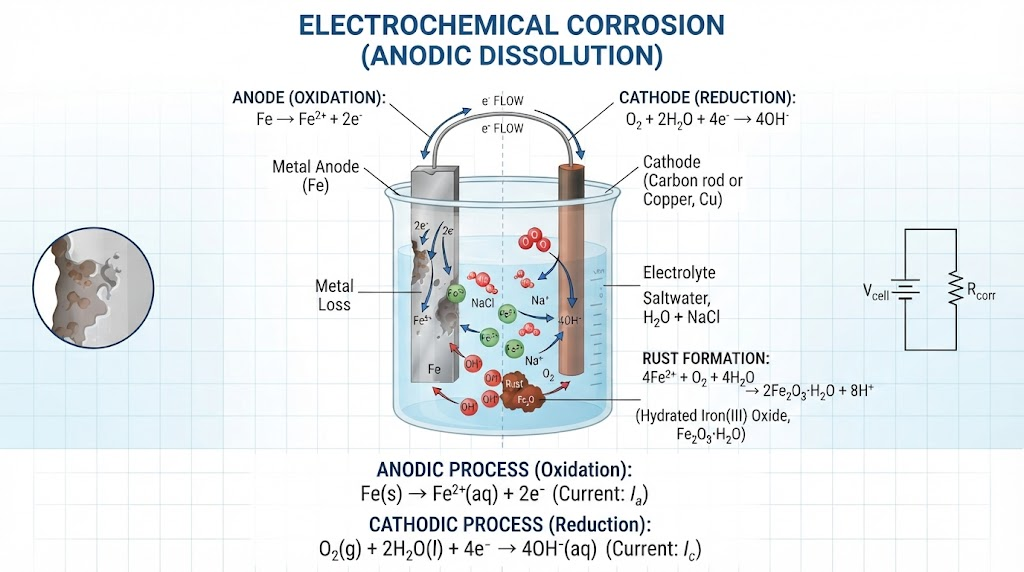
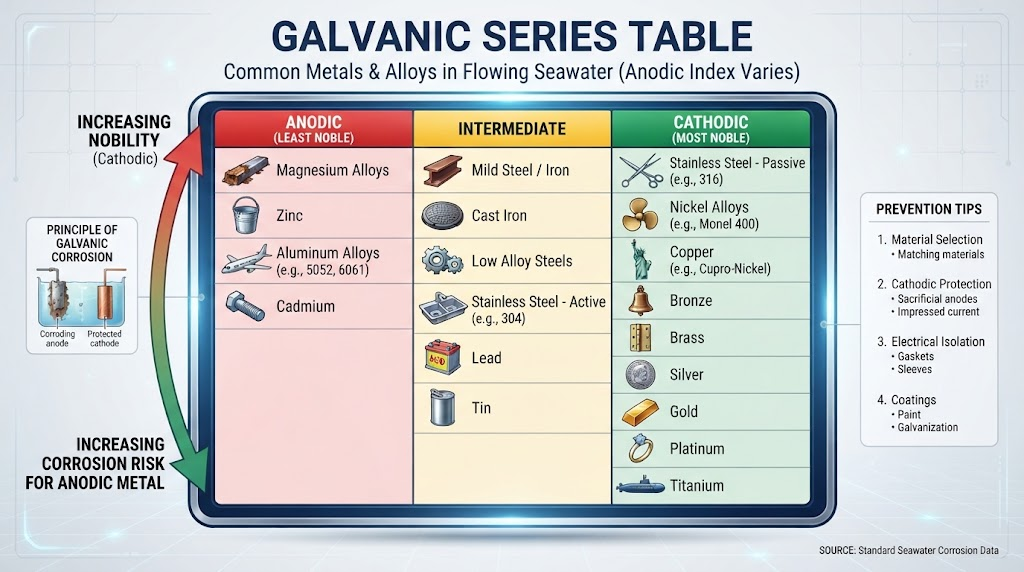
Galvanic corrosion operates on the fundamental principle of standard reduction potentials within the Electromotive Force (EMF) series. When two dissimilar metals are immersed in an electrolyte and electrically connected, the metal with the lower electrode potential undergoes accelerated oxidation.
Pressurized hot water tanks are lined with vitreous porcelain enamel, but thermal expansion cycles inevitably cause micro-fractures known as holidays. These fissures expose raw carbon steel (electrode potential $\approx -0.44\text{ V}$ vs. Standard Hydrogen Electrode).
Cathodic Protection Definition: An electrochemical corrosion mitigation technique compliant with NACE International Standards that converts active anodic sites on a metal surface to passive cathodic sites via continuous electron transfer.
An anode rod constructed from a more electronegative material supplies electrons directly to the tank shell. These electrons satisfy local reduction reactions—primarily oxygen reduction ($O_2 + 2H_2O + 4e^- \rightarrow 4OH^-$)—at the steel interface, maintaining protective polarization.
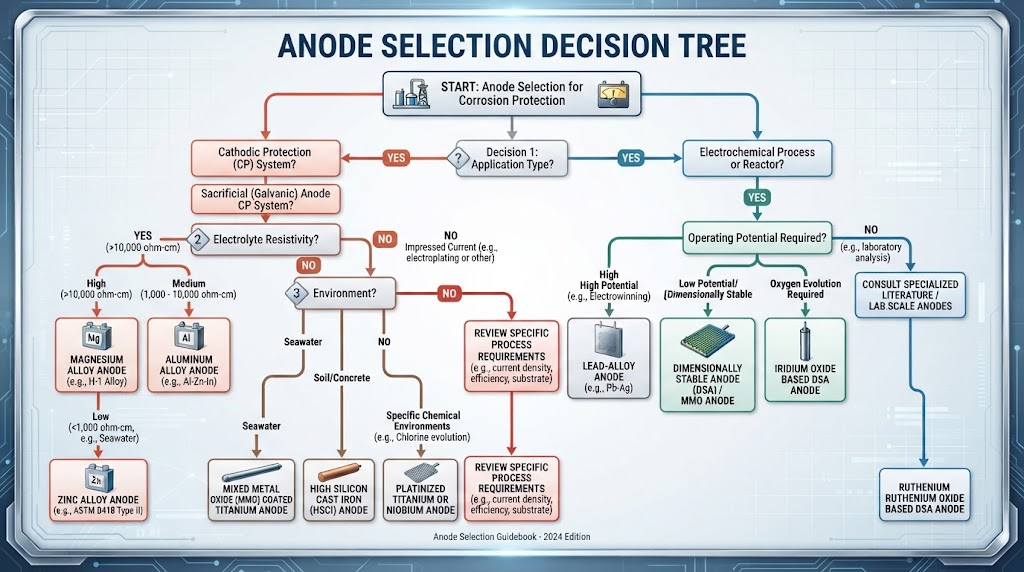
Sacrificial anodes rely purely on their chemical composition and natural driving voltage to corrode in place of the steel tank. The three common base metals exhibit distinct electrochemical properties, operating voltages, and operational trade-offs.
| Alloy Type | Standard Potential ($V$ vs SHE) | Theoretical Capacity ($Ah/kg$) | Primary Application Environment |
|---|---|---|---|
| High-Potential Magnesium (AZ63B) | $-2.37\text{ V}$ | $\approx 2,200$ | Moderate to high-resistivity, unsoftened municipal water |
| Standard Aluminum (Al-Zn-In) | $-1.66\text{ V}$ | $\approx 2,980$ | Hard water with elevated chloride content ($>100\text{ ppm}$) |
| Aluminum-Zinc Blend (92/8%) | $-1.75\text{ V}$ | $\approx 2,650$ | Wells exhibiting trace hydrogen sulfide gas formation |
In well water systems containing naturally occurring sulfate-reducing bacteria (SRB), magnesium sacrificial rods accelerate foul odors. The rapid oxidation of magnesium releases surplus hydrogen ions ($2H^+ + 2e^- \rightarrow H_2$).
SRB species utilize this free hydrogen to reduce native sulfates ($SO_4^{2-}$) into dissolved hydrogen sulfide gas ($H_2S$). Aluminum-zinc rods suppress this reaction marginally via zinc ion toxicity toward bacteria, though they do not eradicate the chemical mechanism permanently.
Ion-exchange water softeners swap scale-forming calcium ($Ca^{2+}$) and magnesium ($Mg^{2+}$) ions for sodium ($Na^+$) or potassium ($K^+$) ions. While this prevents limescale buildup on heating elements, it fundamentally transforms the electrolyte chemistry inside the tank.
Sodium ions increase electrical conductivity by up to $300\%$, dropping electrolyte resistivity from $3,000\text{ }\Omega\cdot\text{cm}$ down to $<1,000\text{ }\Omega\cdot\text{cm}$. In a low-resistivity environment, the driving potential of a magnesium rod causes excessive current output.
Accelerated Consumption: Standard sacrificial rods dissolve in 12 to 24 months instead of 4 to 6 years.
Premature Depletion: Once the rod core wire is exposed, the galvanic current collapses to zero.
Aggressive Tank Attack: The highly conductive softened water directly attacks exposed tank micro-fissures, leading to early tank rupture.
Impressed Current Cathodic Protection (ICCP) replaces sacrificial consumption with an inert, electrically driven anode system. Using an external regulated direct-current power supply, an ICCP system continuously injects precise milliamperes of protective current into the water volume.
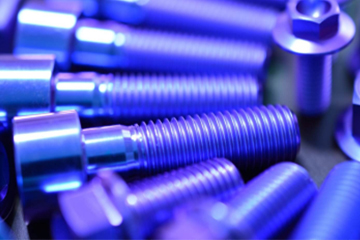
The gold standard substrate for ICCP systems is commercially pure titanium. Precision engineered MMO coated titanium anode rods employ a Grade 1 titanium base according to ASTM B348 specifications, thermally coated with an electrocatalytic mixed metal oxide layer consisting of iridium oxide ($IrO_2$) and tantalum oxide ($Ta_2O_5$).
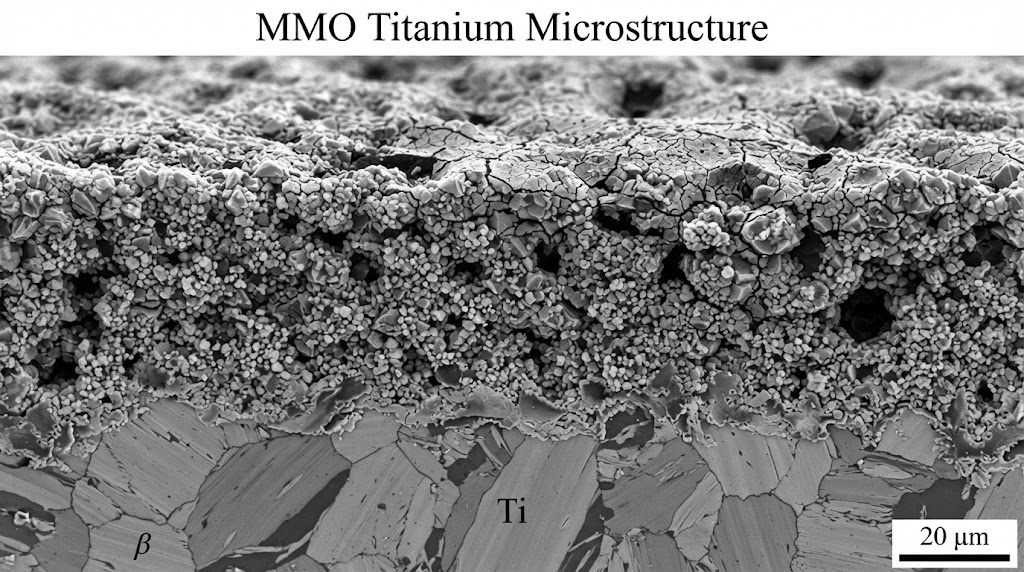
The MMO outer layer acts as an electrocatalyst for water electrolysis ($2H_2O \rightarrow O_2 + 4H^+ + 4e^-$) rather than dissolving into the water. This provides critical operating advantages:
Zero Metal Dissolution: The titanium core experiences no dimensional loss or physical depletion over decades of service.
Odor Elimination: Because it generates no excessive hydrogen gas, sulfate-reducing bacteria cannot synthesize hydrogen sulfide odor.
Self-Regulating Current: The digital potentiometer adjusts voltage in real time based on changes in water conductivity and mineral density.
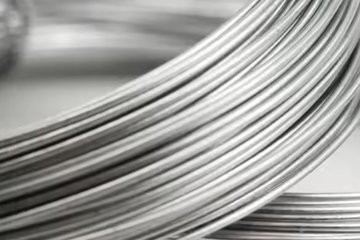
For high-reliability installations, manufacturers utilize high-purity Grade 1 titanium wire and substrates to ensure zero substrate pitting and maximum coating adhesion under continuous polarization.
China Titanium Factory establishes structural cathodic sizing using the CTF Cathodic Specification Matrix (CTF-CSM). This framework enables OEM engineers and facility managers to match vessel dimensions and water chemistry to the exact anode profile required for 100% cathodic coverage.
The protective current requirement ($I_{req}$) is governed by the exposed steel surface area ($A_s$), the anticipated lining defect factor ($f_{hol}$, typically $0.5\%$ to $3\%$), and the target polarization current density ($J_c$):
$$I_{req} = A_s \times f_{hol} \times J_c$$ Where $J_c$ in hot potable water ranges from $10\text{ mA/m}^2$ to $25\text{ mA/m}^2$ under standard operating temperatures ($60^\circ\text{C}$).
| Vessel Volume (Gallons / Liters) | Electrolyte Conductivity ($\mu S/cm$) | Recommended Anode Topology | Target Current Output ($mA$) |
|---|---|---|---|
| $40-60\text{ Gal} / 150-230\text{ L}$ | $100-500$ (Standard Municipal) | Single MMO Titanium Rod ($300\text{ mm}$) | $15 - 35\text{ mA}$ |
| $40-80\text{ Gal} / 150-300\text{ L}$ | $>800$ (Softened / High TDS) | MMO Titanium with Active Micro-controller | $35 - 75\text{ mA}$ |
| $100-500\text{ Gal} / 380-1900\text{ L}$ (Commercial) | All Chemistries | Dual Array MMO Titanium ($600-1000\text{ mm}$) | $100 - 350\text{ mA}$ |
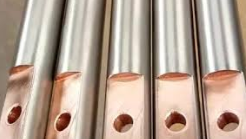
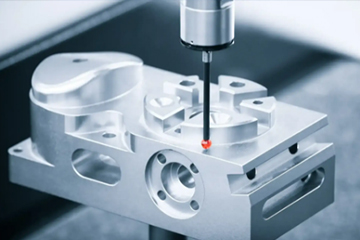
To ensure robust mechanical integration, systems rely on precision-threaded titanium CNC machined fittings that seal commercial tank bungs against extreme hydraulic pressure cycles without dielectric breakdown, serving as fundamental hardware across large-scale industrial cathodic protection solutions.
Monitoring the physical and electrical degradation of an anode rod prevents unrecoverable vessel failure. As an anode nears the end of its useful lifespan, specific indicators appear in the water supply and system operation.
Rust-Colored Water: Red or brown discoloration in hot water lines indicates the anode is exhausted and raw steel tank oxidation is actively generating iron oxide ($Fe_2O_3$).
Rotten Egg Sulfur Odor: Rapid chemical reaction between degraded magnesium cores and sulfate-reducing bacteria indicates the need for an immediate alloy change or powered titanium upgrade.
Popping or Rumbling Tank Sounds: Sacrificial aluminum rods generate significant aluminum hydroxide precipitate. This gel-like sediment collects at the tank bottom, trapping steam bubbles that pop aggressively during burner cycles.
Core Wire Exposure: Physical extraction showing more than $75\%$ loss of original sacrificial metal mass or visible central steel core wire indicates zero residual protection.
ICCP Controller Diagnostic Faults: On powered titanium systems, an active red LED status indicator warns of open circuits, dry-fire conditions, or extreme scale accumulation.
Replacing an anode rod requires systematic depressurization and mechanical extraction. Following industrial maintenance protocols prevents injury and thread stripping.
Isolate Energy Sources: Disconnect electric breaker panels or rotate the gas control valve to the "OFF" or "Pilot" setting.
Shut Down Cold Water Supply: Close the cold water inlet valve feeding the top of the heater.
Depressurize and Drain: Attach a hose to the bottom boiler drain valve. Open a hot water faucet inside the facility to break vacuum pressure, and drain 2 to 5 gallons of water to lower the water level below the tank head.
Access the Anode Bung: Remove the hex-head plastic cover on top of the water heater jacket insulation to expose the $3/4\text{ inch}$ NPT fitting.
Break Thread Seizure: Fit a heavy-duty $1\text{-}1/16\text{ inch}$ deep well 6-point socket onto a $1/2\text{ inch}$ drive breaker bar or cordless impact wrench. Turn counter-clockwise to break the factory thread lock.
Extract and Inspect: Lift the rod vertically. If clearance is limited overhead, bend or segment sacrificial rods upon extraction.
Install New Anode: Apply 5 to 6 wraps of heavy-duty PTFE thread sealant tape or anaerobic pipe sealant to the male threads. Thread the new sacrificial rod or MMO titanium powered anode by hand, then torque to $40-50\text{ ft-lbs}$.
Refill and Re-Energize: Open cold water inlet valve completely with a hot faucet open until continuous water flow purges all air from the system. Inspect the bung for leaks, then restore electrical or gas power.
Assessing the total cost of ownership (TCO) across a 15-year operational lifecycle reveals the economic advantage of advanced non-sacrificial cathodic systems. While traditional magnesium rods carry lower initial purchase costs, their recurring replacement cycle generates significant cumulative expense.
| Expense Category | Sacrificial Magnesium System (3-Year Cycle) | Powered MMO Titanium Anode (Permanent) |
|---|---|---|
| Initial Hardware Acquisition | $40 (Included with tank) | $150 - $220 |
| Replacement Hardware Costs (15 Years) | $200 (4 replacements @ $50) | $0 (Non-depleting substrate) |
| Labor & Plumbing Service Fees | $600 - $1,000 (4 service calls) | $0 (Zero routine replacement) |
| Premature Tank Rupture Risk | High (If replacement missed) | Negligible (Continuous active current) |
| Total 15-Year Projected Cost | $840 - $1,240+ | $150 - $220 |
A water heater will function hydraulically without an anode rod, but the unprotected carbon steel tank will begin corroding rapidly. Depending on water temperature, pH, and dissolved solids, removing the anode can lead to inner vessel perforation and tank failure within 6 to 18 months.
In standard municipal water, a magnesium or aluminum rod lasts between 3 and 5 years. In structures utilizing ion-exchange water softeners or high-conductivity well water, sacrificial rods typically deplete entirely within 1 to 2 years.
Under the Magnuson-Moss Warranty Act, installing an aftermarket component does not void tank warranties unless the specific component causes direct mechanical failure. Powered titanium anodes maintain the required polarization voltage without altering the tank structure.
Softened water contains elevated levels of sodium ions, which dramatically increase the electrical conductivity of the water. Lower electrical resistance enables higher galvanic current flow, accelerating the rate at which sacrificial magnesium or aluminum atoms donate electrons and dissolve.



Contact Us
Room 21003, 10th Floor, Unit 2, Building 1, Xianning International Plaza, No.29 Xianning West Road, Beilin District, Xi'an City
Copyright © Xi'an Shiguang Jingyan Technology Co., Ltd. All Rights Reserved.