














Heat Anodizing Titanium Color Chart: Thermal Oxidation (°C/°F) vs. Electrolytic Type III (DC Volts), Alpha-Case Limits & AMS 2488 Specs
Understanding the heat anodizing titanium color chart requires separating decorative thin-film interference from structural metallurgical integrity. When titanium is exposed to controlled thermal oxidation (350 °C–650 °C) or electrolytic Type III anodizing (10 V–115 V DC), a transparent titanium dioxide (TiO2) barrier film grows from 10 nm to 120 nm. While both processes yield the same titanium heat color chart spectrum without dyes, thermal exposure above 480 °C (896 °F) drives interstitial oxygen diffusion, forming brittle alpha-case that degrades fatigue life by up to 65%.
Physics of Titanium Coloration: Why Does Titanium Change Color When Heated?
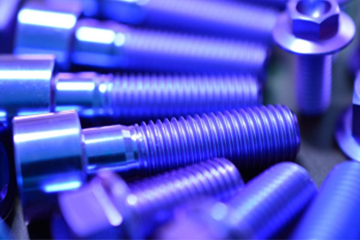
Titanium changes color when heated or anodically polarized because atmospheric oxygen reacts with the bare metal to grow a transparent, high-refractive-index Titanium Dioxide (TiO2) rutile/anatase film. This oxide layer contains zero dyes or pigments; instead, it produces vivid interference colors through thin-film optical phase cancellation across 10 nm to 120 nm thicknesses.
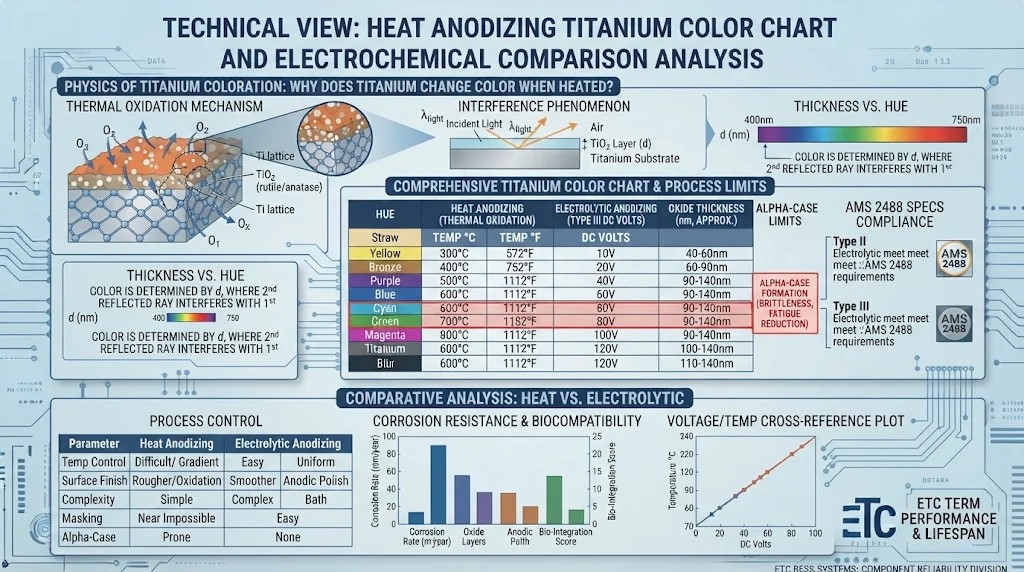
When incident white light strikes the oxidized titanium surface, a fraction reflects immediately off the air-TiO2 boundary, while the remaining light refracts into the oxide (refractive index n ≈ 2.4), reflects off the underlying metallic titanium substrate, and exits back into the air. Because the second wave travels a longer optical path, the two waves interfere constructively or destructively depending on the oxide thickness (d) and viewing angle (θ).
The governing Bragg interference equation for constructive reinforcement is: 2 × n × d × cos(θ) = m × λ, where m is the interference order (1, 2, 3...) and λ is the reinforced visible wavelength (380 nm–750 nm). Consequently, answering does titanium change color when heated comes down to controlled oxide growth: as temperature or DC voltage increases, d increases, shifting the reinforced wavelength λ across the visible spectrum.
Natural Titanium Colour vs. Oxidized Interference Spectrum (10 nm to 120 nm)
At ambient room temperature, natural titanium exhibits a muted metallic silver-grey colour because its native passive TiO2 film is only 1.5 nm to 4.0 nm (15 Å–40 Å) thick. Because this native barrier is far thinner than the shortest visible light wavelength (380 nm), no optical interference occurs, and all incident wavelengths reflect uniformly.
Elevating thermal energy or applying anodic DC potential drives oxygen ions through the passive barrier, thickening the transparent TiO2 layer into the first-order interference regime (10 nm–50 nm). At 10–15 nm, short blue wavelengths cancel out, leaving pale straw-gold. At 30–45 nm, yellow and red wavelengths cancel, producing rich violet and deep cobalt blue.
Beyond 55 nm, the optical path enters the second-order Bragg regime. The spectrum cycles back through pale silver-blue (55–65 nm) into bright yellow-gold (70–80 nm), magenta-rose (85–95 nm), and finally high-order teal and emerald green (100–120 nm) before film porosity scatters light into dull grey.
Grade 2 Commercially Pure (CP) vs. Grade 5 (Ti-6Al-4V) Thermal Coloration Variance
Commercially Pure (CP) Titanium Grade 1 and Grade 2 consist of a single-phase hexagonal close-packed (HCP) alpha microstructure (> 99% Ti), whereas Titanium Grade 5 (Ti-6Al-4V) and Grade 23 ELI feature a two-phase alpha-beta duplex microstructure. This metallurgical phase difference directly alters thermal and electrolytic coloration chroma, brightness, and required process parameters.
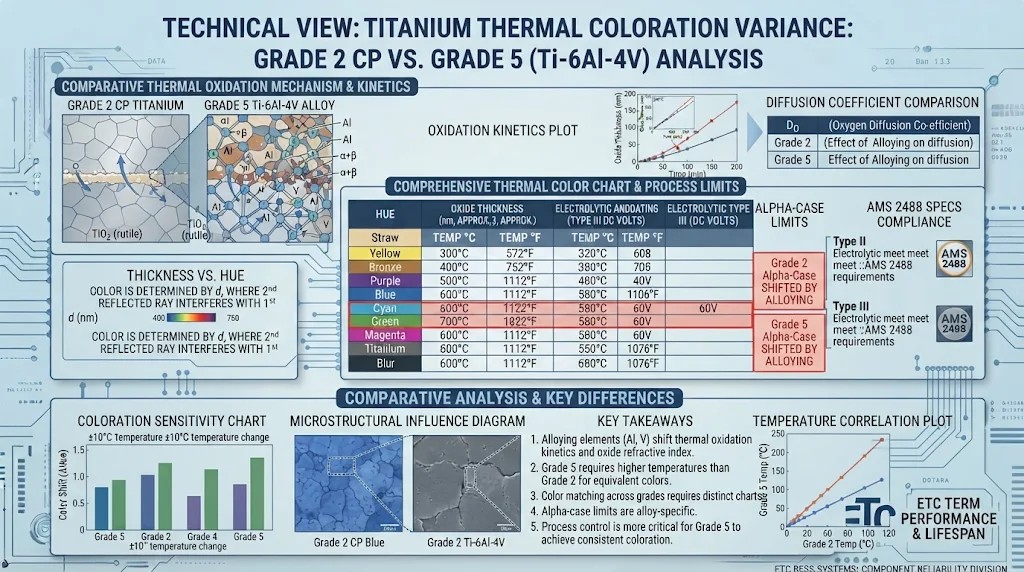
In Grade 5 Ti-6Al-4V, the 6 wt% Aluminum (alpha stabilizer) and 4 wt% Vanadium (beta stabilizer) partition unevenly during oxidation, forming mixed Al2O3 and V2O5 dopants inside the TiO2 lattice. These dopants alter the effective refractive index and create microscopic thickness variations across alpha and beta grain boundaries.
As a result, CP Grade 2 yields 25%–35% higher CIELAB chroma saturation and brighter jewel-tone blues and golds. Grade 5 Ti-6Al-4V shifts slightly darker or matte and typically requires a 15 °C–25 °C higher thermal soak (or 3 V–5 V higher DC potential) to achieve the equivalent optical thickness. For full alloy baselines, review our Titanium Metal Grades (CP Grade 1, Grade 2 vs. Grade 5 Ti-6Al-4V & Grade 23 ELI) specification hub.
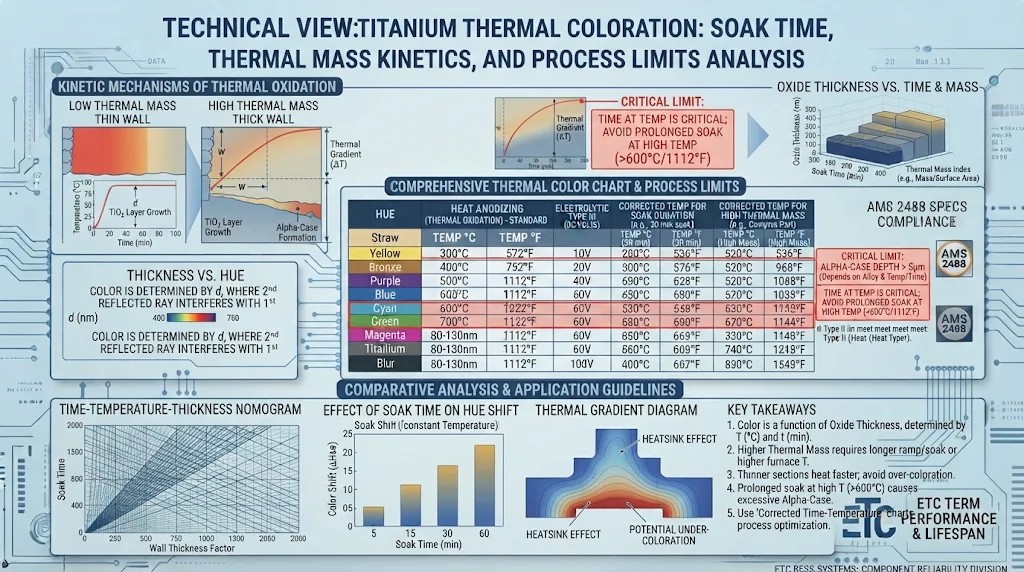
Heat Anodizing Titanium Color Chart: Unified Temperature (°C/°F), Electrolytic Voltage (DC V) & Oxide Thickness Matrix
The unified heat anodizing titanium color chart below correlates atmospheric thermal oxidation temperatures (°C and °F) with room-temperature AMS 2488 Type III electrolytic anodizing voltages (DC V) and resulting TiO2 film thicknesses (nm/Å). Engineers and QA inspectors use this matrix to select safe coloration parameters and enforce AWS D1.9 weld heat-tint rejection boundaries.
| Interference Color | Thermal Temp (°C / °F) | Soak Time (3 mm Wall) | Electrolytic Type III (DC V) | TiO2 Thickness (nm / Å) | Metallurgical Risk Status | AWS D1.9 Weld HAZ Disposition |
|---|---|---|---|---|---|---|
| Silver (Native) | 20 °C (68 °F) | N/A | 0 V | 1.5–4 nm (15–40 Å) | Safe Passive Zone | Acceptable (Optimal Argon Shielding) |
| Pale Straw / Light Gold | 385 °C (725 °F) | 8–12 min | 10–15 V | 10–15 nm (100–150 Å) | Safe Passive Zone | Acceptable (Superficial Oxide) |
| Dark Gold / Bronze | 415 °C (779 °F) | 10–15 min | 18–22 V | 18–24 nm (180–240 Å) | Transition Boundary | Conditional (Light Brushing Required) |
| Purple / Violet | 445 °C (833 °F) | 12–18 min | 25–28 V | 25–30 nm (250–300 Å) | Approaching Alpha-Case | Reject (Shielding Loss; Pickle/Etch) |
| Deep Cobalt Blue | 485 °C (905 °F) | 15–20 min | 30–35 V | 32–42 nm (320–420 Å) | Alpha-Case Embrittlement Zone | Reject (Sub-Surface Hardness Spike) |
| Light Ice Blue | 525 °C (977 °F) | 15–25 min | 40–48 V | 45–55 nm (450–550 Å) | Alpha-Case Embrittlement Zone | Reject (Mandatory Cut-Out / Strip) |
| Bright Yellow-Gold (2nd Order) | 565 °C (1049 °F) | 20–25 min | 55–65 V | 65–78 nm (650–780 Å) | Severe Alpha-Case (> 500 HV) | Reject (Mandatory Cut-Out & Scrap) |
| Rose / Magenta | 600 °C (1112 °F) | 20–30 min | 75–85 V | 82–95 nm (820–950 Å) | Severe Alpha-Case & Warping | Reject (Mandatory Cut-Out & Scrap) |
| Teal / Emerald Green | 645 °C (1193 °F) | 25–35 min | 95–115 V | 100–120 nm (1000–1200 Å) | Critical Fatigue Degradation | Reject (Mandatory Cut-Out & Scrap) |
| Powdery Gray / White Scale | > 750 °C (> 1382 °F) | > 30 min | N/A (Spalling) | > 150 nm (Porous Rutile) | Catastrophic Embrittlement | Reject (Gross Atmospheric Contamination) |
Heating Duration (Soak Time) vs. Wall Thickness & Thermal Mass Kinetics
Titanium oxidation follows a logarithmic-to-parabolic Arrhenius growth rate governed by both temperature and soak duration. Because titanium possesses extremely low thermal conductivity (k ≈ 6.7 W/m·K for Grade 5 Ti-6Al-4V vs. 16.4 W/m·K for CP Grade 2), thick cross-sections lag behind thin edges, causing uneven color gradients if ramp rates are uncontrolled.
| Section / Wall Thickness | Typical Component Example | Recommended Furnace Ramp Rate | Soak Time at Target Temp (385 °C–600 °C) |
|---|---|---|---|
| 0.5 mm – 1.2 mm | Single-wall titanium bottle, shim stock, foil | 10 °C / min | 5 – 8 minutes |
| 2.0 mm – 5.0 mm | CNC brackets, pocket clips, sheet panels | 8 °C / min | 12 – 18 minutes |
| 8.0 mm – 15.0 mm | Machined flanges, bar stock, thick bosses | 5 °C / min | 22 – 30 minutes |
| 20.0 mm – 25.0 mm | Heavy billets, valve bodies | 3 °C / min | 35 – 45 minutes |
Why True Red and Black Cannot Be Achieved via Atmospheric Heat Coloring
True crimson red and jet black cannot be produced through atmospheric heat anodizing or Type III electrolytic interference. In the 620 nm–750 nm red wavelength band, overlapping second-order constructive interference peaks mix with shorter blue/violet wavelengths, producing bronze-pink, rose, or magenta rather than pure monochromatic red.
Attempting to achieve black by heating titanium above 750 °C (1382 °F) destroys the coherent interference film entirely, generating a porous, powdery spalling rutile scale (dull matte charcoal-grey) accompanied by severe substrate embrittlement. Industrial applications requiring true black titanium must specify AMS 2488 Type II plasma electrolytic oxidation (dark gray) or Physical Vapor Deposition (PVD) Diamond-Like Carbon (DLC) coatings.
Heat Sources & Process Control: Butane Torches, Propane/MAP-Pro vs. Calibrated Air Muffle Furnaces
Selecting the thermal energy delivery method determines whether heated titanium achieves uniform, repeatable chromatic fidelity or suffers from localized hot-spotting and hydrocarbon contamination. Shop-floor gas torches offer rapid localized heating for non-critical hardware, whereas precision multi-part production requires PID-controlled electric air-circulating muffle furnaces with ±2 °C spatial uniformity.
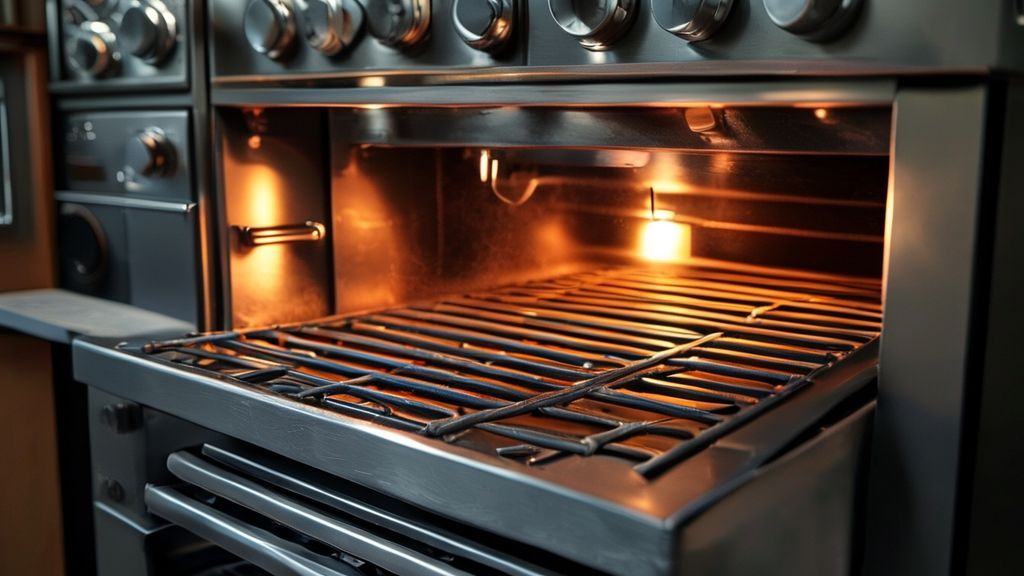
Can You Use a Butane Torch vs. Propane/MAP-Pro or Electric Muffle Furnace?
A clean butane torch (adiabatic flame temperature ~1430 °C in air) or propane/MAP-Pro torch (~1960 °C) can heat small, thin-walled titanium items—such as pocket clips, EDC rings, single-wall titanium bottles, or exhaust tips—into the 385 °C–600 °C coloration range. However, open-flame heating carries high risks of localized overheating, hydrocarbon soot deposition, and uneven rainbow gradients.
Because titanium's thermal diffusivity is roughly one-tenth that of aluminum, heat from a butane or propane flame concentrates at the point of impingement rather than conducting evenly. Consequently, thin edges rapidly overshoot into dull grey (> 700 °C) before adjacent thick sections reach straw-gold. For repeatable batch production on complex 5-axis 5-Axis Titanium CNC Machining & Tight-Tolerance Surface Finishing parts, electric muffle furnaces are mandatory.
Surface Preparation Mandates: Acid Pickling (HNO3/HF Ratio), Ultrasonic Degreasing & Fingerprint Failure
Meticulous surface preparation per ASTM F86 and AMS 2488 is non-negotiable before thermal or electrolytic coloration. Human skin oils (sebum, sodium chloride, and fatty acids from a single ungloved fingerprint) carbonize during heating or locally insulate the surface during anodizing, permanently burning a dull brown or grey thumbprint into the TiO2 layer.
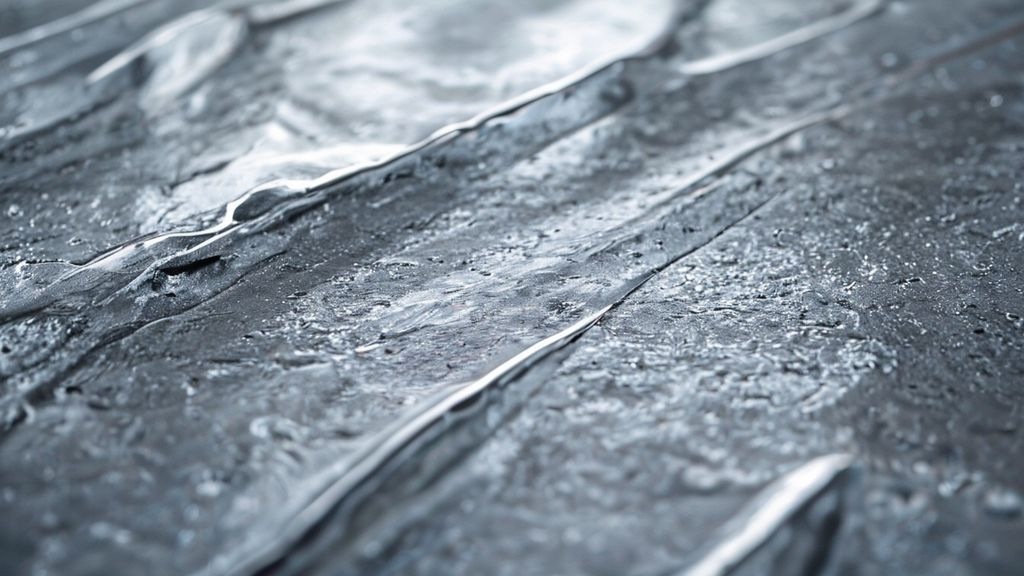
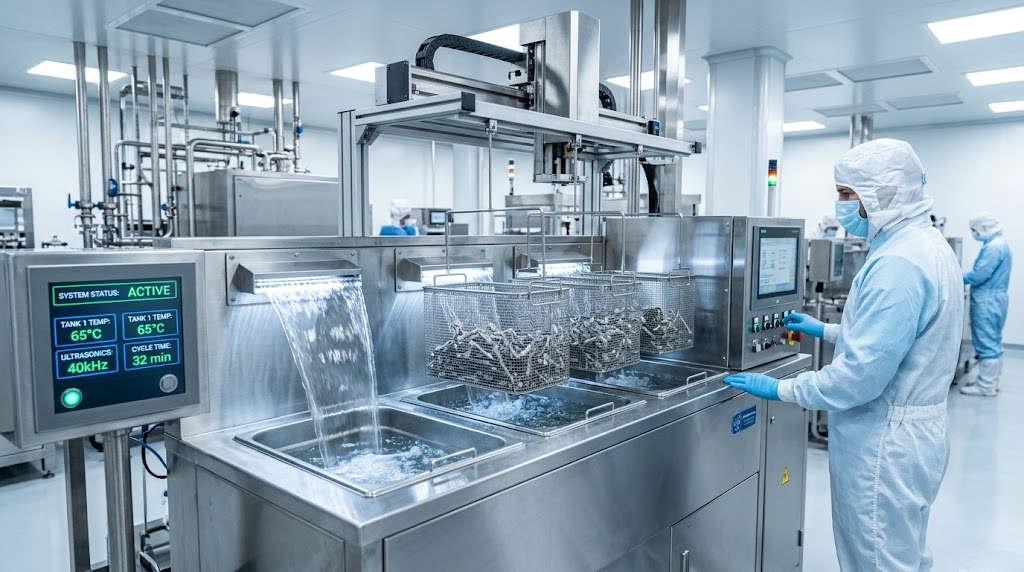
The industrial pre-treatment sequence requires ultrasonic alkaline degreasing, acetone/IPA solvent wiping, and chemical acid pickling in a bath of 30%–35% by volume Nitric Acid (HNO3) + 2%–3.5% by volume Hydrofluoric Acid (HF) in deionized water at 45 °C–55 °C. Maintaining a strict ≥ 10:1 HNO3-to-HF weight ratio strips native mill oxides while suppressing atomic hydrogen absorption (< 20 ppm pickup).
Impact of Surface Finish (Mirror Polished Ra 0.05 μm vs. CNC Machined vs. Bead Blasted) on Color Chroma
Substrate surface roughness (Ra) governs the ratio of specular to diffuse light reflection through the transparent TiO2 film, dramatically altering perceived color vibrancy. Mirror-buffed or electropolished surfaces (Ra ≤ 0.05 μm) reflect light specularly, yielding vivid, jewel-like metallic tones.
Precision 5-axis CNC turned or milled surfaces (Ra 0.4–0.8 μm) produce a directional satin iridescent sheen. Conversely, glass-bead or Al2O3 grit-blasted surfaces (Ra 1.6–3.2 μm) trap incident light and accelerate oxidation due to elevated specific surface area, resulting in muted pastel or matte colors that shift rapidly toward dull grey.
Metallurgical Boundaries: Thermal Oxidation Failure Modes vs. Electrolytic Anodizing (AMS 2488)
Aerospace OEMs and medical device manufacturers strictly prohibit thermal heat coloring on structural titanium components because temperatures above 480 °C (896 °F) compromise metallurgical integrity. While decorative hardware tolerates surface oxidation, load-bearing fasteners, compressor blades, and surgical implants require room-temperature electrolytic anodizing under AMS 2488.
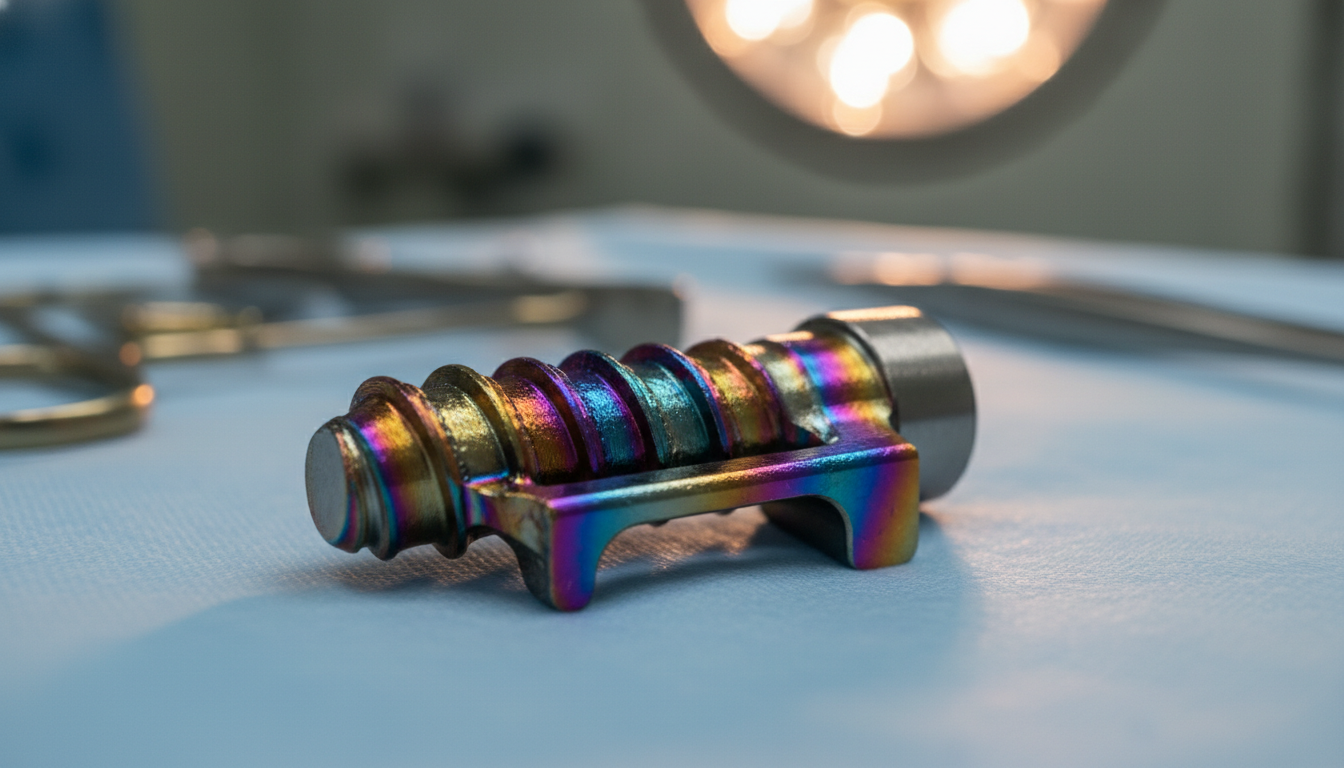
Alpha-Case Embrittlement (> 480 °C / 896 °F), Fatigue Degradation & Dimensional Distortion
Above 480 °C (896 °F), atmospheric oxygen and nitrogen diffuse interstitially into the titanium alpha lattice, forming a hard, brittle sub-surface layer known as alpha-case. Achieving thermal blue, teal, or green (500 °C–650 °C) inevitably generates this oxygen-enriched layer, spiking surface Vickers hardness from ~320 HV30 to > 550 HV0.1.
This triggers a catastrophic structural failure chain: Interstitial O/N Diffusion → Sub-Surface Alpha-Case Layer → Surface Micro-Cracking under Cyclic Tensile Load → Up to 65% Drop in High-Cycle Fatigue Limit. Additionally, thermal exposure relieves residual machining stresses asymmetrically in thin-walled CNC aerospace or medical parts, causing dimensional warping beyond ±0.01 mm tolerances.
AWS D1.9 & AMS 2681 Weld Heat-Affected Zone (HAZ) Color Inspection Criteria
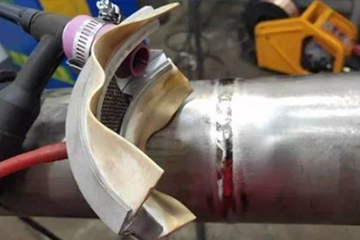
In structural welding per AWS D1.9 and ISO 15614-5, the titanium heat color chart serves as a mandatory Non-Destructive Testing (NDT) gauge for argon shielding integrity. Bright silver weld beads indicate optimal inert gas coverage and are fully acceptable.
Light straw or pale gold (< 20 nm oxide) is acceptable after light stainless-steel wire brushing. However, dark straw, violet, or deep blue indicates shielding loss above 450 °C and is rejected unless chemical pickling removes the oxide and verifies no hardness spike. Powdery grey or flaky white scale (> 650 °C) mandates immediate weld cut-out and scrap. For certified assemblies, explore our Custom Titanium Fabrication & AWS D1.9 Argon-Shielded Welding Service.
Electrolytic Anodizing (AMS 2488 Type II & Type III) vs. Thermal Heat Coloring Matrix
Comparing thermal oxidation against AMS 2488 Type III (electrolytic color anodizing in dilute trisodium phosphate or citric acid at 20 °C) and AMS 2488 Type II (alkaline anti-galling conversion coating) clarifies the optimal process for industrial procurement.
| Process Parameter | Thermal Oxidation (Heat Anodizing) | AMS 2488 Type III (Electrolytic Color) | AMS 2488 Type II (Anti-Galling) |
|---|---|---|---|
| Operating Temperature | 350 °C – 650 °C (662 °F – 1202 °F) | 20 °C ± 2 °C (Ambient Room Temp) | 20 °C – 25 °C (Alkaline Bath) |
| Alpha-Case Formation | Yes (> 480 °C); Severe Fatigue Loss | Zero (0% Fatigue Degradation) | Zero (0% Fatigue Degradation) |
| Dimensional Stability | Poor (Thermal Stress-Relief Warping) | Excellent (< 0.0002 mm Change) | Excellent (2–4 μm Matte Build) |
| Biocompatibility (ASTM F86) | Non-Compliant for Implants | Fully Compliant (ISO 10993 / ASTM F86) | Compliant for Non-Articulating |
| Wear & Galling Resistance | Minimal (Thin-Film Interference) | Minimal (Color-Coding Only) | High (Prevents Thread Seizing) |
Technical FAQ: Engineering Verification & Shop-Floor Troubleshooting
Shop-floor machinists and QA managers frequently encounter unexpected optical shifts, thermal seal failures, and alpha-case verification requirements. The following technical answers resolve these recurring operational challenges.
Why does heated titanium change color immediately upon touching it with bare fingers?
Bare fingers deposit a microscopic film of sebum and skin oils (refractive index n ≈ 1.47) onto the TiO2 interference layer. This oil film alters the effective optical path length of reflected light, instantly shifting a vibrant blue or purple surface to dull brown or grey. Wiping the surface with pure Acetone or Isopropyl Alcohol (IPA) removes the oil and immediately restores the true interference wavelength.
Can I heat-anodize a double-wall vacuum-insulated titanium bottle without rupturing the vacuum seal?
No. Double-wall vacuum-insulated titanium bottles rely on a high-temperature brazed or laser-welded vacuum pinch-off seal at the base. Heating the bottle to 400 °C–600 °C expands trapped residual gases, softens the braze alloy, and risks implosion or permanent loss of vacuum insulation. Always use room-temperature electrolytic Type III anodizing for vacuum-insulated vessels.
How do you strip and reset an over-heated titanium color back to silver without ruining CNC tolerances?
To strip an unwanted interference oxide layer back to bare silver, immerse the component in a controlled 30% HNO3 + 2.5% HF acid pickle at 45 °C for 30–60 seconds, followed by immediate deionized water rinsing. However, if the part was heated above 480 °C, acid pickling alone cannot remove deep sub-surface alpha-case; mechanical stock removal (0.5 mm–1.2 mm) is required.
How do QA labs verify zero alpha-case contamination per AMS 2642 and ASTM E384?
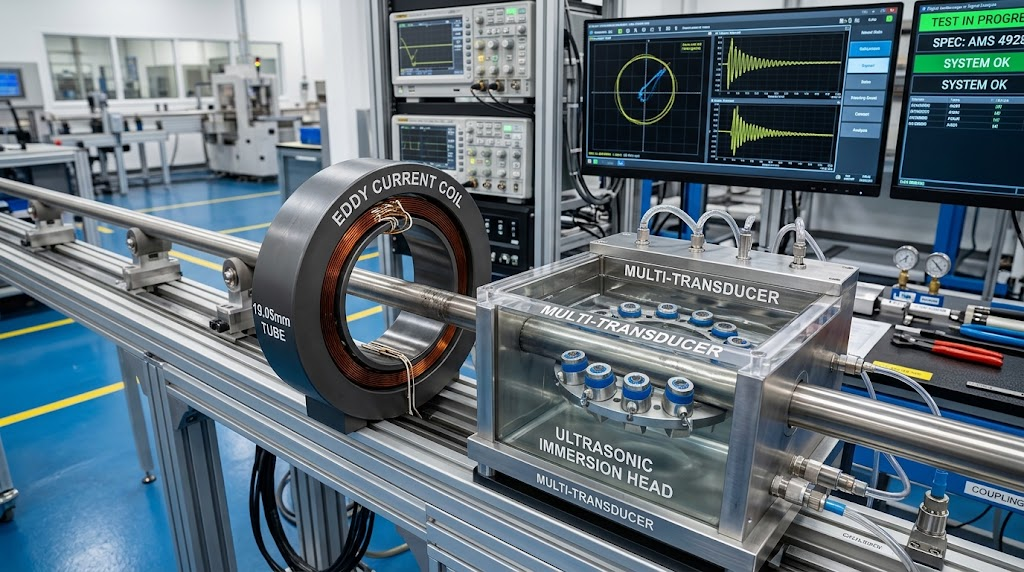
Certified QA laboratories verify zero alpha-case through three protocols: (1) AMS 2642 blue-etch anodize surface inspection; (2) metallographic cross-sectioning etched with Kroll's reagent at 400× magnification to confirm zero white oxygen-stabilized alpha layer; and (3) ASTM E384 microhardness traversal from the edge inward to confirm no hardness spike (> 40 HV above core).
Request a 12-Hour DFM Feasibility Review & EN 10204 3.1 Mill Test Dossier
Eliminate alpha-case embrittlement and batch color variance by partnering with our AS9100D and ISO 9001:2015 certified metallurgical team. Follow our 3-step engineering consultation pathway to lock in your surface finishing and dimensional tolerances:
Step 1: Upload 3D CAD/DFM files (STEP, IGES, DWG) specifying target ASTM/AMS grade, surface roughness (Ra), and target AMS 2488 voltage color or non-tinted pickled finish.
Step 2: Receive a 12-hour DFM feasibility report, pre-anodizing acid activation protocol, and sample EN 10204 3.1 MTC / AMS 2631 ultrasonic inspection dossier.
Step 3: Conduct a direct video engineering consultation with our Senior Metallurgical Staff to finalize CIELAB ΔE color tolerances and ISPM-15 seaworthy export packaging.
Submit Engineering RFQ & Request MTC Dossier
Direct Engineering Desk: sales@chinatitaniumfactory.com