




















Titanium vs Aluminum in Modern Motorsport: Engineering Fundamentals
In high-tier racing, the titanium vs aluminum strength to weight ratio in racing dictates component survival, unsprung mass dynamics, and packaging efficiency. Grade 5 titanium offers an exceptional specific yield strength of ~199 kN·m/kg compared to 7075-T6 aluminum's ~179 kN·m/kg, while maintaining infinite fatigue endurance limits and high-temperature structural integrity.
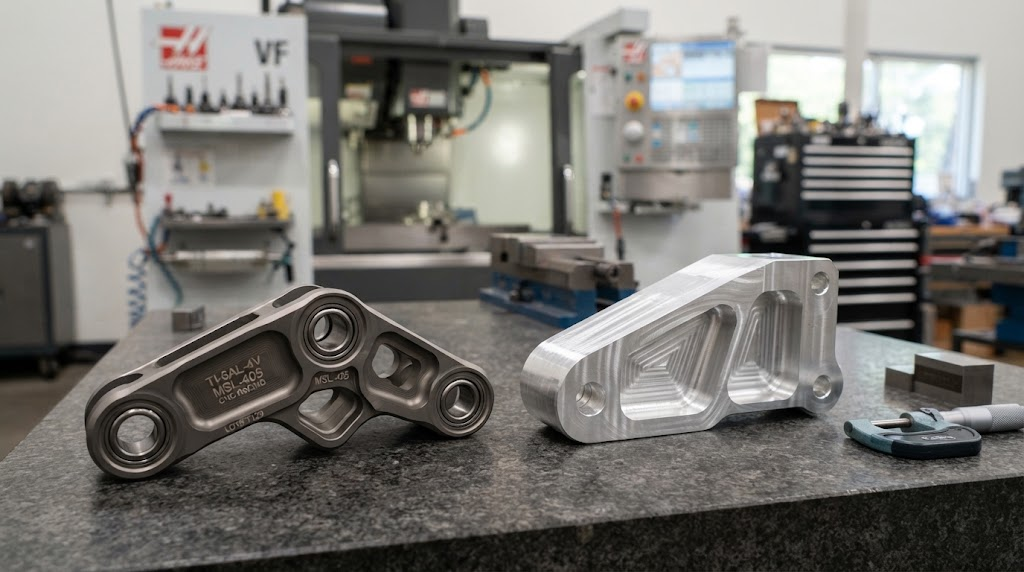
Lightweight alloy selection in competitive motorsport is not simply a race to the lowest bulk density. While aerospace-grade aluminum alloys such as 6061-T6, 7075-T651, and 2024-T3 provide low material density (2.70 to 2.81 g/cm³), they exhibit lower ultimate yield strengths and lack a true endurance limit under cyclic loading.
Alpha-beta titanium alloys, most notably Ti-6Al-4V (Grade 5), possess a density of 4.43 g/cm³ but deliver tensile yields exceeding 880 to 1100 MPa. In our metallurgical testing at China Titanium Factory, structural components engineered from forged titanium reliably reduce section thickness while outperforming high-strength aluminum under dynamic shear and peak tensile spikes.
Mechanical Properties and Strength-to-Weight Mathematical Benchmark
Specific strength defines the mechanical efficiency of any load-bearing motorsport structure. It is mathematically expressed as the material's yield strength ($\sigma_y$) or ultimate tensile strength ($\sigma_u$) divided by its mass density ($\rho$):
Specific Yield Strength ($\text{SS}_y$) Formula:
$$\text{SS}_y = \frac{\sigma_y \text{ (MPa)}}{\rho \text{ (g/cm}^3\text{)}} = \text{kN}\cdot\text{m/kg}$$
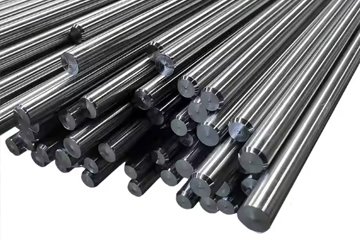
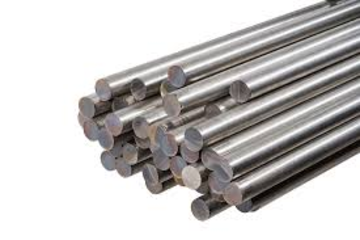
When evaluated strictly by yield strength to density ratio, AMS 4928 Grade 5 Titanium Bars and Rods outperform high-grade 7075-T651 aluminum by over 11% in yield efficiency and surpass 6061-T6 by more than 100%.
| Alloy Designation | Standard Spec | Density ($\rho$) | Yield Strength ($\sigma_y$) | Tensile Strength ($\sigma_u$) | Specific Yield Strength | Elastic Modulus ($E$) |
|---|---|---|---|---|---|---|
| Ti-6Al-4V (Grade 5) | ASTM B348 / AMS 4928 | 4.43 g/cm³ | 880–920 MPa | 950–1050 MPa | 198.6–207.6 kN·m/kg | 114 GPa |
| Aluminum 7075-T651 | ASTM B221 / AMS 4045 | 2.81 g/cm³ | 503 MPa | 572 MPa | 179.0 kN·m/kg | 71.7 GPa |
| Aluminum 6061-T6 | ASTM B221 / AMS 4027 | 2.70 g/cm³ | 276 MPa | 310 MPa | 102.2 kN·m/kg | 68.9 GPa |
| Aluminum 2024-T3 | AMS 4037 / QQ-A-250/4 | 2.78 g/cm³ | 345 MPa | 483 MPa | 124.1 kN·m/kg | 73.1 GPa |
| Ti-6Al-4V ELI (Grade 23) | ASTM F136 / AMS 4930 | 4.43 g/cm³ | 828 MPa | 900 MPa | 186.9 kN·m/kg | 114 GPa |
The Specific Stiffness Paradox: Young's Modulus vs Density Explained
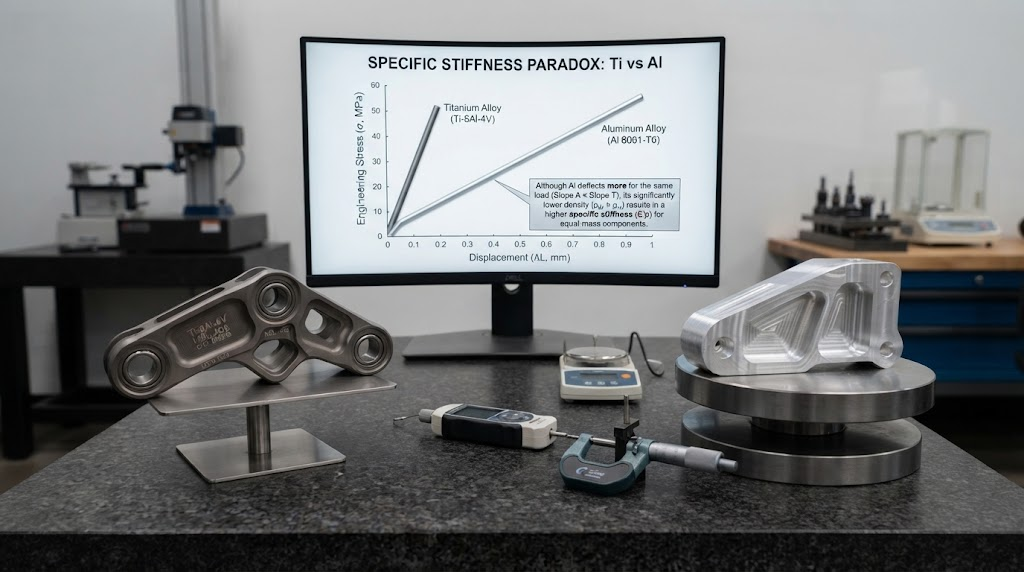
Race engineers frequently encounter a metallurgical reality known as the Specific Stiffness Paradox. While titanium is significantly stiffer in absolute terms than aluminum ($E = 114\text{ GPa}$ vs $71.7\text{ GPa}$), their specific stiffness ratios ($E/\rho$) are virtually identical:
Ti-6Al-4V Grade 5: $114\text{ GPa} / 4.43\text{ g/cm}^3 = 25.73\text{ GPa}/(\text{g/cm}^3)$
7075-T6 Aluminum: $71.7\text{ GPa} / 2.81\text{ g/cm}^3 = 25.51\text{ GPa}/(\text{g/cm}^3)$
When an application is purely deflection-critical and unconstrained by envelope dimensions, aluminum often wins geometrically. The flexural rigidity of a beam scales with the second moment of area ($I$), which increases with the cube of the thickness ($h^3$). Aluminum allows a designer to increase cross-sectional thickness for the exact same mass, yielding higher structural resistance to bending.
Conversely, when tight packaging limits physical geometry, titanium dominates. If section thickness cannot be expanded due to aerodynamic clearances, suspension kinematics, or internal engine packaging, titanium delivers 59% greater absolute stiffness and double the strength within the exact same volume envelope.
Cyclic Fatigue Limits and Crack Propagation Under Race Loads
Under repeated cyclic track loads, structural materials behave fundamentally differently according to their S-N (Wöhler) fatigue curves.
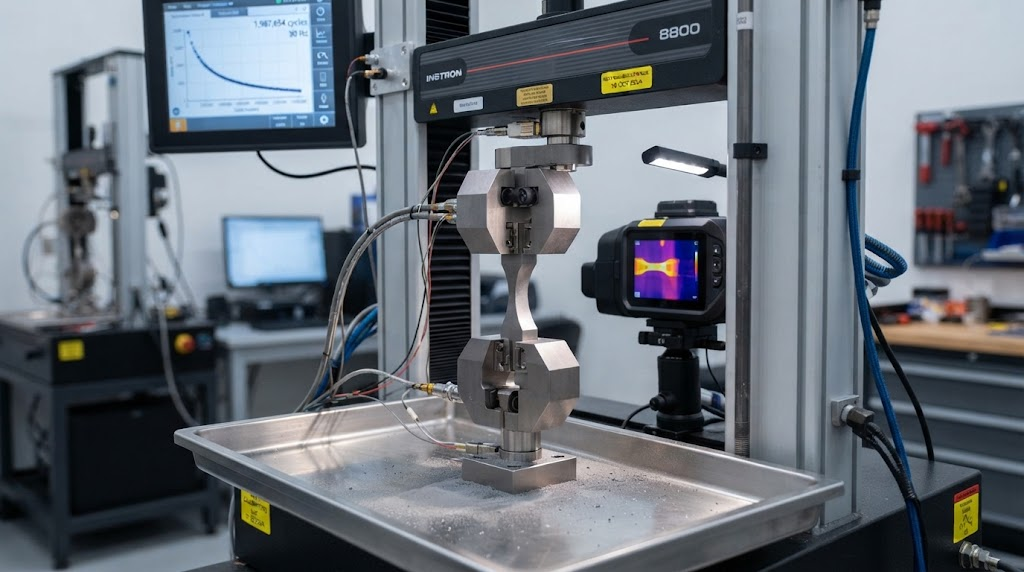
Grade 5 Titanium exhibits a true fatigue endurance limit at approximately 510 MPa ($10^7$ cycles under reversed bending). If dynamic operating stresses remain below this threshold, the component will theoretically never experience fatigue failure.
Fatigue Mechanics Insight: Aluminum alloys (including 7075-T6 and 6061-T6) have no endurance limit. Their S-N curve slopes downward continuously; every stress cycle, regardless of how small, causes microstructural lattice dislocations that eventually nucleate fatigue cracks.
In endurance racing (such as WEC 24-hour events or IMSA), aluminum suspension links and uprights have a finite operational lifespan and require scheduled replacement to avoid catastrophic brittle fracture. Titanium components manufactured by China Titanium Factory withstand billions of dynamic load cycles without micro-crack propagation, ensuring long-term structural reliability.
Thermal Operational Thresholds: High-Temperature Integrity
Motorsport powertrains, turbocharger housings, and brake assemblies generate severe thermal gradients. The mechanical properties of aluminum deteriorate rapidly once temperatures exceed 150°C (302°F).
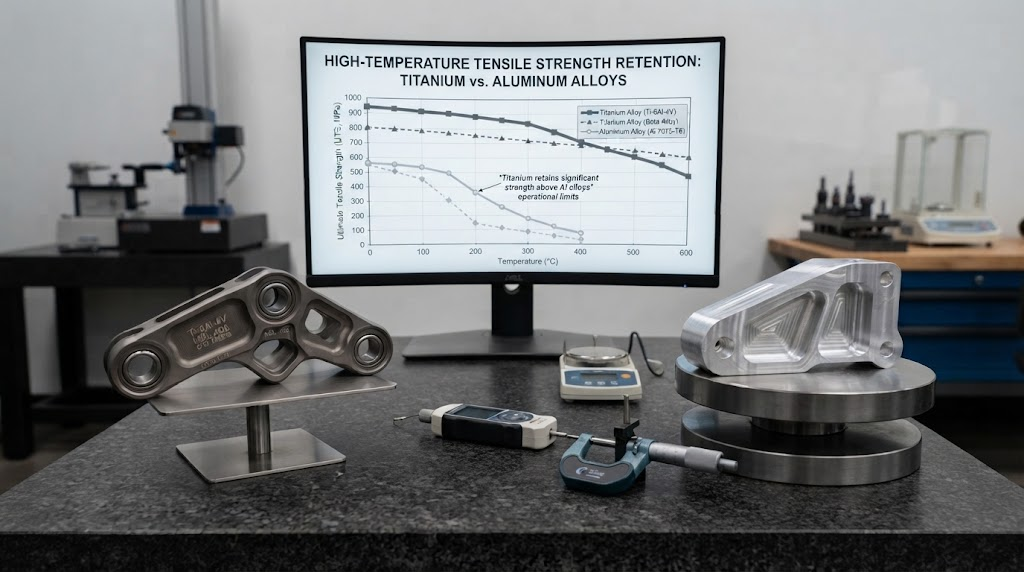
At 200°C, 7075-T6 aluminum loses over 50% of its room-temperature yield strength due to precipitate over-aging. By 300°C, its structural integrity collapses entirely.
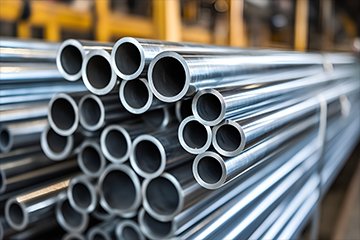
Titanium alloys operate reliably in high-heat zones. Grade 5 retains over 80% of its yield strength at 350°C and maintains usable structural properties up to 450°C. Commercially pure titanium (Grade 2) and near-alpha alloys used in High-Performance Titanium Exhaust Tubing withstand sustained exhaust gas temperatures up to 600°C without excessive scale formation or wall degradation.
Motorsport Subsystem Breakdown: Where Titanium Wins vs Where Aluminum Dominates
Suspension Uprights, Control Arms, and Unsprung Mass Optimization
Reducing unsprung mass accelerates suspension damper reaction time, maintaining higher tire contact patch grip over track curbs. For large, complex suspension uprights (knuckles), 5-axis CNC machined 7075-T6 aluminum billet remains an effective choice due to geometric stiffness advantages and reduced machining cost.
However, for pushrods, pullrods, spherical bearing housings, and anti-roll bar drop links, Motorsport Titanium CNC Machined Parts provide higher tensile fatigue life and foreign-object impact resilience with a smaller aerodynamic frontal profile.
Engine Valvetrain, Connecting Rods, and Reciprocating Components
In high-RPM racing engines (9,000–14,000 RPM), reciprocating mass generates exponential inertial forces ($F = m \cdot r \cdot \omega^2$). While aluminum connecting rods are occasionally used in drag racing for their dampening capacity, their low fatigue life necessitates rebuilds after tens of passes.
Ti-6Al-4V and Ti-6Al-2Sn-4Zr-2Mo connecting rods and valve retainers reduce reciprocating inertia by 40% compared to high-strength steel while surviving hundreds of hours of cyclic rev cycles without dimensional stretch or bore ovalization.
Exhaust Headers, Downpipes, and Thermal Zones
Aluminum is completely unusable for primary exhaust routing due to its low melting point (approx. 660°C) and rapid thermal softening. In contrast, thin-wall Grade 1 or Grade 2 CP Titanium tubing (0.8 mm to 1.2 mm wall thickness) reduces exhaust system mass by 45–55% compared to 304/321 stainless steel, while outperforming heavier nickel alloys (Inconel 625) in naturally aspirated applications.
Critical Fasteners, Wheel Studs, and Anti-Galling Engineering
Aluminum fasteners lack the shear capacity and yield point required for hub, drivetrain, and chassis mounting. Grade 8.8 and 10.9 steel bolts provide strength but add unneeded rotational and chassis mass.
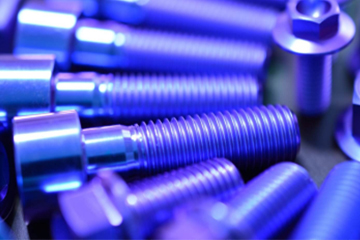
Precision-machined Grade 5 Titanium Fasteners and Wheel Studs provide 950+ MPa tensile strength, saving up to 45% weight against steel. To prevent adhesive thread galling under high-torque pit stop impacts, our manufacturing process incorporates physical vapor deposition (PVD) Diamond-Like Carbon (DLC) and micro-arc oxidation surface treatments.
The China Titanium Factory Dynamic Load Material Selection Protocol
To assist race engineers in making empirical material decisions, our engineering team uses a standardized five-parameter framework:
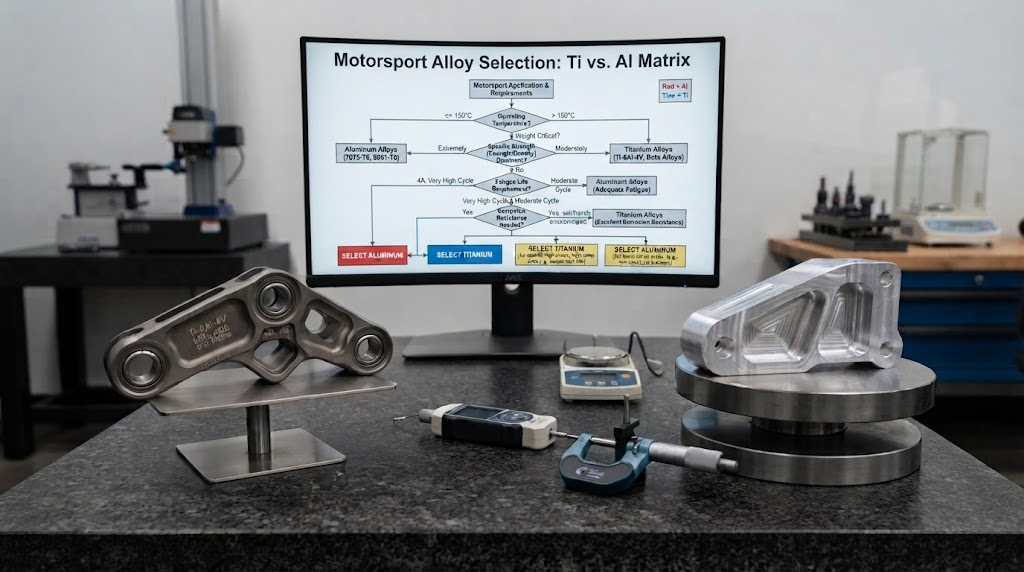
Dynamic Load Index (DLI): Evaluate whether the part operates under pure static load or severe cyclic reversal. If fatigue cycles exceed $10^6$, select Grade 5 Titanium over 7075-T6.
Thermal Exposure Zone (TEZ): Quantify the sustained peak temperature. If $T_{\text{operating}} > 150^\circ\text{C}$, eliminate aluminum immediately in favor of titanium.
Dimensional Packaging Factor (DPF): Determine if geometric boundaries allow section thickness expansion. If the design envelope is constrained, specify titanium to leverage its 114 GPa Young's Modulus and higher yield strength.
Fatigue Cycle Target (FCT): Distinguish between sprint race components (short duty cycle) and endurance chassis members (24-hour or full-season life requirements).
Target Cost-Per-Gram Value: Calculate whether the lap-time delta justifies raw titanium procurement and CNC cycle times.
Total Cost of Ownership (TCO) and Cost-Per-Gram Weight Reduction Analysis
While aluminum raw material costs less per kilogram, total cost of ownership (TCO) analysis often favors titanium in professional motorsport programs. Aluminum components in high-vibration zones suffer cumulative micro-fatigue damage, requiring regular crack testing and premature replacement.
| Evaluation Metric | 7075-T6 Aluminum Billet | Grade 5 Titanium (Ti-6Al-4V) |
|---|---|---|
| Initial Manufacturing Cost | $180 / unit | $420 / unit |
| Assembly Mass | 480 grams | 310 grams (-35.4%) |
| Recommended Service Lifespan | 1 Season (Fatigue Limit Risk) | 3+ Seasons (Below Endurance Limit) |
| 3-Season Replacement Cost (x4 Corners) | $2,160 (12 units total) | $1,680 (4 units total) |
| Net Financial & Performance Yield | Higher recurring cost, heavier unsprung mass | $480 net savings + 680g unsprung weight reduction |
Manufacturing, Forging, and CNC Precision Machining Capabilities
Machining Ti-6Al-4V requires rigid machining setups and controlled parameters due to titanium's low thermal conductivity ($7.2\text{ W/m}\cdot\text{K}$ compared to aluminum's $130\text{ W/m}\cdot\text{K}$). Cutting heat concentrates at the tool-workpiece interface rather than dissipating into the chips.
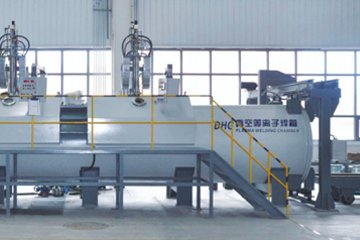
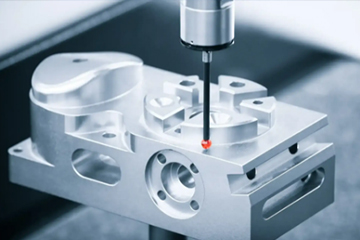
At China Titanium Factory, our manufacturing facility utilizes high-pressure through-spindle coolant (up to 70 bar), solid carbide and ceramic tooling with specialized AlTiN coatings, and optimized trochoidal toolpaths. We process bar stock and forgings certified to ISO 9001, AS9100D, AMS 4928, and ASTM B348.
Every motorsport batch undergoes 100% ultrasonic immersion testing to guarantee zero internal voids, inclusions, or alpha-case surface embrittlement.
Real-World Motorsport Case Studies: Track-Proven Performance
In our collaborative engineering projects with international GT3 endurance racing teams, China Titanium Factory redesigned the rear upright pushrod clevis and anti-roll bar drop assemblies. Previously machined from 7075-T651 aluminum, these components experienced progressive micro-yielding at the rod-end spherical seat under sustained curb impacts.
By transitioning to closed-die forged and 5-axis CNC machined Grade 5 Titanium (Ti-6Al-4V):
Total assembly weight dropped by 41.2% across the rear axle assembly.
Deflection under maximum 3.2G cornering loads was reduced by 18%.
The team completed consecutive 24-hour endurance races with zero fatigue-induced hardware replacements.
Frequently Asked Questions (FAQ)
Is titanium lighter than aluminum in racing applications?
No. Titanium has a higher density (~4.43 g/cm³) than aluminum (~2.70–2.81 g/cm³). However, because titanium is nearly twice as strong as motorsport-grade aluminum, a properly engineered titanium part requires less total volume of material, often resulting in a finished component that is 30% to 45% lighter than its aluminum counterpart.
When should a racecar designer choose 7075-T6 over Grade 5 Titanium?
7075-T6 aluminum is preferable when components are large, unconstrained by spatial packaging, operate below 100°C, and are designed strictly for bending stiffness rather than peak tensile yield or infinite cyclic fatigue life (e.g., large front splitter brackets or main chassis mounting plates).
How do you prevent thread galling with titanium racing fasteners?
Titanium threads gall when friction strips the native passive oxide film, leading to metal-to-metal cold welding. We mitigate this by applying Diamond-Like Carbon (DLC) coatings, physical vapor deposition, specialized anti-seize pastes (molybdenum disulfide), or micro-arc oxidation during CNC finishing.
Procure Certified Motorsport Titanium from China Titanium Factory
Precision Mill-Direct Titanium for Motorsport & Aerospace
China Titanium Factory manufactures and supplies high-grade titanium bar stock, seamless tubing, forged billets, and custom 5-axis CNC machined components to motorsport programs globally. All shipments are supplied with complete EN 10204 3.1 chemical and mechanical test certificates.
Submit your CAD models (STEP/IGES) or engineering specifications for rapid prototyping and production runs.