




































A titanium quote with the lowest price per kilogram is not automatically the lowest-cost option. Two suppliers may be quoting different grades, dimensions, tolerances, inspection levels, delivery terms, or usable quantities. Before comparing prices, make each offer describe the same material and the same scope of supply.
Start with the same specification and delivery scope for every supplier. Then compare the cost of conforming material delivered to your facility, including required processing, inspection, packaging, freight, import charges, and realistic yield loss. Review lead time, traceability, and payment terms separately.
Executive Procurement Summary
Direct answer: Compare titanium quotations only after aligning grade, product standard, form, dimensions, tolerances, quantity basis, inspection, documentation, and delivery terms. Then calculate the total cost of accepted usable material at the destination. A lower price per kilogram is not a like-for-like saving if it excludes required processing, testing, freight, or import charges.
Normalize grade, product standard, form, dimensions, condition, and quantity before comparing unit prices.
Confirm whether each quote includes required processing, inspection, test reports, certificates, packaging, and lot traceability.
Use the same weight basis and delivery location; identify the named place and Incoterms® edition on every international offer.
Compare delivered cost per accepted usable kilogram or per conforming part, not only the supplier’s quoted price per kilogram.
Review lead time, payment terms, and supply risks separately so they remain visible in the award decision.
Material Quote Scope & Comparison Parameters
Use this baseline to make sure each supplier is pricing the same requirement. Add project-specific values and acceptance criteria to the RFQ.
| Quote field | Information to specify or verify |
|---|---|
| Grade & specification | Exact titanium grade, governing product standard, delivery condition, and any customer-specific requirements |
| Form & dimensions | Product form, dimensions, tolerances, surface condition, lengths, and cut requirements |
| Quantity & weight basis | Order quantity, MOQ, actual or theoretical weight basis, and permitted delivery variation |
| Quality package | Required tests, inspection level, certificate type, heat/lot traceability, and reports |
| Delivery basis | Named destination, Incoterms® rule and edition, packing, freight, insurance, and import charges |
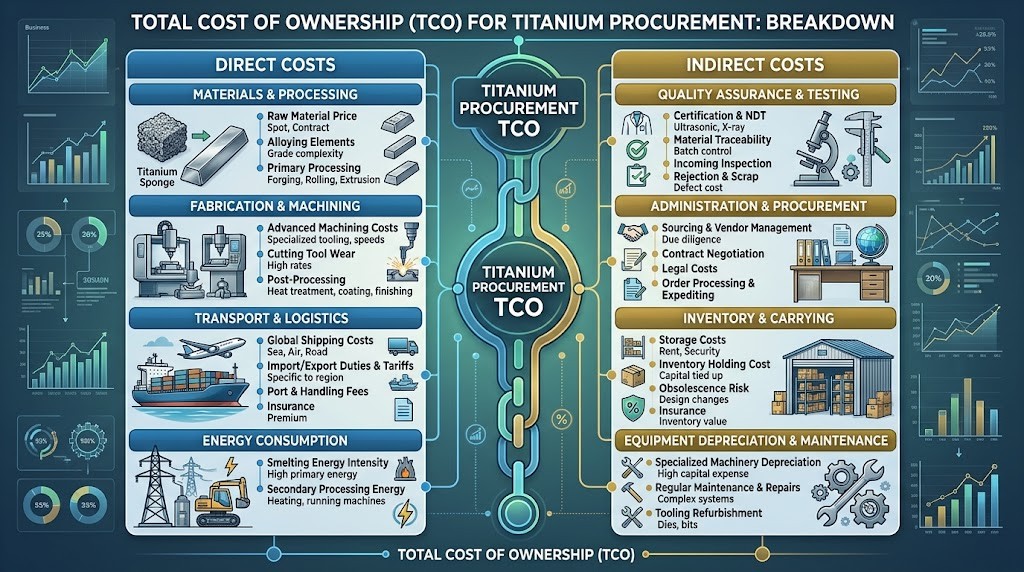
Why price per kilogram can be misleading
Price per kilogram is useful only when the quoted material is comparable. A low figure may apply to a different titanium grade, a larger dimensional tolerance, an unfinished product form, a different certification package, or a shipment term that leaves freight and import costs to the buyer.
Even when two offers list the same grade, the commercial scope may differ. One supplier may include cutting to length, independent testing, protective packaging, and heat-specific documentation. Another may quote standard mill stock and charge for those items separately. The useful comparison is the cost of each conforming lot delivered to the required location, not just its quoted price per kilogram.
Start by making the specifications identical
Before comparing the prices, create one common specification for every supplier. The request for quotation (RFQ) should identify the titanium grade and applicable product standard, product form, dimensions, quantity, dimensional tolerances, required condition, inspection requirements, documentation, packaging, delivery destination, and requested delivery date.
Grade and standard: State the exact grade and governing specification, including any customer or industry-specific requirements. Do not assume that two commercially similar grade names are interchangeable.
Product form and dimensions: Specify bar, plate, sheet, billet, tube, forging, or another form, along with diameter or thickness, width, length, and any required cut lengths.
Condition and processing: Identify the required heat-treatment or delivery condition, surface finish, machining or grinding, and any special processing.
Tolerances and acceptance criteria: Define dimensional limits and the inspection or test acceptance criteria that apply to the order.
Quantity basis: Clarify whether the price is based on ordered weight, theoretical weight, actual scale weight, or finished net weight. Specify whether over- or under-delivery is permitted.
Documentation and traceability: List the required material test reports or certificates, heat or lot traceability, and any additional inspection records.
For traceability-sensitive purchases, connect the material identification on the product to its lot or heat documentation. For more on the documents and checks involved, see Titanium Heat Traceability Verification & MTC Auditing and the Titanium Supplier Audit Questions: Engineering QA Guide.
Normalize every quote line before comparing totals
Build a side-by-side comparison with the same scope on every row. Mark each item as included, excluded, optional, or not confirmed. A blank in a supplier’s quotation is not proof that the item is included.
| Comparison item | What to confirm | Why it affects the comparison |
|---|---|---|
| Material identity | Grade, standard, product form, delivery condition, and source requirements | A different grade or condition is a different product, not a cheaper equivalent. |
| Dimensions and tolerances | Finished dimensions, tolerance range, straightness, surface condition, and cut-length requirements | Closer tolerances or additional finishing can change both price and usable yield. |
| Quantity and weight basis | Order quantity, minimum order quantity (MOQ), weight calculation method, and permitted quantity variation | Suppliers may price by different weight bases or add charges for small lots and cut pieces. |
| Testing and inspection | Required tests, sampling frequency, inspection level, reports, and third-party inspection if specified | Testing scope can be a separate cost and may affect release timing. |
| Certificates and traceability | Required certificate type, heat or lot identity, and documentation language or format | A low offer may exclude records needed for customer approval or regulated applications. |
| Processing and conversion | Cutting, peeling, grinding, machining, heat treatment, or other agreed services | Material quoted in a less-finished state may require additional cost and time after receipt. |
| Packaging and handling | Protection, bundling, labeling, export packing, and handling charges | Packaging affects both the invoice and the risk of damage, contamination, or identification loss. |
| Delivery and commercial terms | Named delivery place, Incoterms® version and rule, freight, insurance, export/import clearance, duties, and taxes | Quotes on different delivery bases do not show the same allocation of logistics costs and risks. |
| Timing and payment | Production lead time, dispatch estimate, validity period, payment schedule, and currency | Timing and cash-flow effects matter commercially but should be shown separately from material unit price. |
How do you compare the cost of usable titanium?
Usable-material cost is the comparable order cost divided by the quantity of material accepted for the intended job. It is different from the quoted price per kilogram because it accounts for required services and the amount of material that can actually be used.
A kilogram price can understate the cost of parts that meet the drawing. If the order requires cutting, machining, or strict dimensional control, some purchased material may become trim, machining allowance, or rejected pieces. Ask each supplier to state the quoted weight basis and expected finished quantity clearly.
Use this calculation to compare offers:
Cost per usable kilogram = total comparable order cost ÷ accepted usable material weight
For planning, “total comparable order cost” can include the quoted material value, required processing, inspection and documentation charges, packaging, freight, insurance, brokerage, duties, and other import charges applicable to the buyer. Subtract or separately account for credits, rebates, or recoverable taxes according to your accounting treatment. Keep the calculation consistent across suppliers.
For machined parts, you can also estimate cost per accepted part by dividing the comparable order cost by the number of parts expected to pass inspection. Use actual or clearly stated assumptions for material utilization and reject rate; do not treat a supplier’s estimate as a guaranteed yield unless the contract makes it one.
Illustrative example: Supplier A’s lower quoted unit price may exclude cutting, required test reports, and freight. Supplier B’s higher unit price may include those items and deliver material closer to the finished dimensions. Once both offers are normalized to the same delivered specification and usable quantity, the apparent price advantage may shrink or reverse. The answer depends on the actual order scope and costs.
Check what the certification and inspection price actually covers
“Certificate included” is too vague for a meaningful comparison. Ask what document will be supplied, whether its results correspond to the ordered lot, how the material will be identified, and whether the requested tests and inspection records are included in the price. If a project requires independent inspection or a specific certificate, name it in the RFQ rather than relying on a general promise of “full certification.”
Also confirm which requirements are mandatory for your application and which are optional. A supplier should not substitute a different test, certificate, or inspection level without your written approval. Where the purchase is safety-critical or controlled by a customer specification, have the responsible engineering or quality function approve the requirements before placing the order.
How do Incoterms® affect a titanium quotation?
Incoterms® are trade rules that allocate specified delivery tasks, costs, and risks between the seller and buyer. When comparing international offers, record the complete delivery term, named place or port, and Incoterms® edition. Incoterms® allocate specified delivery responsibilities, costs, and risks between seller and buyer. The International Chamber of Commerce explains that the 2020 rules provide for allocation of costs and obligations; the U.S. Department of Commerce also summarizes how the rules address shipment, insurance, documentation, customs formalities, and transfer of risk. See the ICC Incoterms® 2020 overview and U.S. Department of Commerce guidance.
Do not compare an EXW offer directly with a delivered-price offer as though the quoted numbers cover the same services. Ask for a comparable delivery basis or add the buyer-paid transport and import costs to the lower-scope quote. Incoterms® do not replace the full sales contract and do not settle every commercial point, such as the product specification, payment timing, or title transfer; make those terms explicit separately.
Evaluate lead time, supply reliability, and payment terms separately
A quote with an attractive total can still be unsuitable if its lead time misses your production window or if the supplier has not confirmed material availability. Separate stock availability from production lead time, and ask whether the quoted date is an estimate or a contractual commitment. Confirm whether testing, document approval, or customer inspection occurs before shipment and is included in the stated schedule.
Payment terms and currency also affect the commercial decision. Compare deposit requirements, balance timing, accepted payment methods, quote validity, and any currency exposure. These factors may affect working capital or procurement risk, but they should not be confused with the cost of the titanium itself.
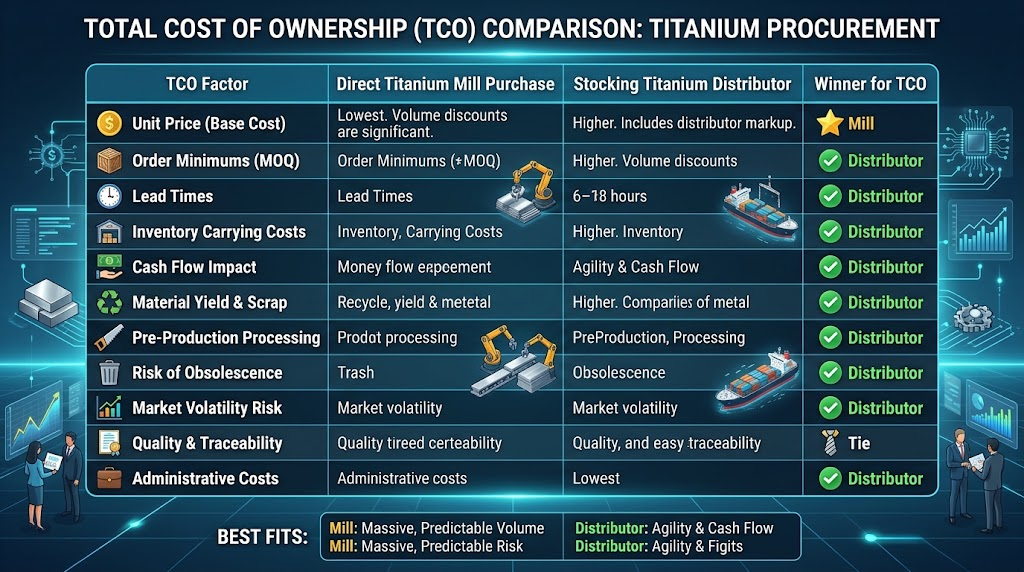
For a direct mill versus distributor comparison, include availability, minimum order size, processing access, and traceability alongside price. This related guide explains the broader sourcing trade-offs: Titanium Sourcing: Direct Mill vs. Distributor Total Cost Analysis.
A simple decision process for titanium quotations
Freeze the requirement. Confirm the grade, specification, form, dimensions, condition, quantity, inspection, documentation, destination, and required date.
Return incomplete offers for clarification. Ask suppliers to identify every exclusion, assumption, surcharge, and optional service.
Normalize the scope. Compare like-for-like quantities, weight bases, processing, certificates, inspection, packaging, and delivery terms.
Calculate delivered usable cost. Include buyer-paid logistics and applicable charges, then account for realistic material yield or accepted output.
Review non-price risks. Confirm traceability, supplier capability, lead-time confidence, quality records, and commercial terms against your project needs.
Document the award basis. Record why the selected offer is the best fit and carry the agreed scope into the purchase order.
Questions to ask before accepting a titanium quote
Does the offer match the exact grade, product standard, condition, dimensions, and tolerances in the RFQ?
Is the price based on theoretical, actual, gross, or net weight, and what quantity variation is allowed?
Which processing, testing, inspection reports, and material certificates are included?
Can the supplied material be traced to the relevant heat or lot documentation?
Are cutting, packaging, freight, insurance, customs clearance, duties, and taxes included or excluded?
What is the named delivery place and the complete Incoterms® rule and edition?
Is the delivery date based on stock or production, and what events could extend it?
What are the MOQ, payment terms, quote validity, and any charges for small lots or special handling?
Frequently asked questions
Should I choose the titanium supplier with the lowest price per kilogram?
Not without confirming that the offers cover the same grade, standard, dimensions, tolerances, processing, inspection, documentation, and delivery scope. Compare the delivered cost of material that meets your requirements, then assess timing and supply risk separately.
What is the total delivered cost of a titanium quote?
It is the cost of the quoted material plus the agreed processing, inspection, packaging, freight, insurance, and applicable import charges needed to receive it at the named destination. Calculate it on the same delivery basis for each supplier, and state separately whether taxes are recoverable.
What costs are commonly missing from a titanium material quote?
Depending on the offer, exclusions may include cutting or finishing, special testing, inspection records, protective export packaging, freight, cargo insurance, brokerage, import duties, taxes, and fees for small quantities. Ask the supplier to list inclusions and exclusions in writing.
How do I compare quotes with different Incoterms®?
Ask suppliers to quote on the same named delivery basis where possible. Otherwise, add the costs and responsibilities that remain with the buyer to each offer, using the complete rule, named place, and edition. Confirm customs and tax treatment with your logistics or trade-compliance provider.
What does “certificate included” mean in a supplier quotation?
It should identify the document type and the lot-specific information or test results supplied. A material test certificate (MTC) is a document associated with material test results; the exact certificate and traceability requirements depend on the purchase specification. State the required documents in the RFQ and confirm them before ordering.
How should I compare a mill-direct quote with a distributor quote?
Compare equivalent material and delivery scope. Consider available stock, MOQ, processing, lead time, documentation, traceability, freight, and the ability to meet the required dimensions. A distributor may provide convenience or smaller quantities, while a mill may offer different processing or sourcing options; the best choice depends on the order.
Compare the complete offer before making a sourcing decision
A fair titanium quote comparison starts with a common specification and ends with a clear view of delivered, usable material cost. Normalize the product, quality requirements, quantity basis, and logistics first. Then weigh lead time, traceability, and commercial terms against the needs of your application.
Need help reviewing a titanium grade, product form, or material documentation requirement? Contact the China Titanium Factory team with your specification and target delivery location to request a like-for-like quotation review.