



















Core Electrochemical & Metallurgical Fundamentals
Aluminum sacrificial anodes deliver an electrochemical capacity of approximately 2,980 Ah/kg at an open-circuit potential of -1.10 V vs. Ag/AgCl, while traditional military-grade zinc yields 780 Ah/kg at -1.05 V vs. Ag/AgCl. In high-salinity seawater, aluminum provides nearly 3.8 times more protective charge per unit mass than zinc, reducing underwater structural weight. Zinc maintains consistent dissolution without micro-alloying dependencies, serving as a legacy standard where tight driving voltage limits are critical.
Cathodic protection (CP) relies on the thermodynamic potential difference between a base structural metal (typically structural steel) and an electronegative galvanic alloy. When submerged in an electrolyte like seawater, the sacrificial anode oxidizes preferentially.
This oxidation releases electrons through the electrical bond to the cathode, forcing the potential of the protected steel structure below its critical corrosion threshold of -0.80 V (or -0.90 V in anaerobic, sulfate-reducing bacterial environments) referenced against a Silver/Silver Chloride (Ag/AgCl) seawater half-cell.

Electrochemical Property Matrix: Zinc vs Aluminum vs Magnesium
Evaluating sacrificial alloys requires balancing physical density against current delivery and dissolution kinetics. The table below presents baseline metallurgical metrics under standardized seawater conditions (32 PSU salinity, 20 °C, resistivity 25 Ω·cm).
| Electrochemical Parameter | Zinc (ASTM B418 Type I) | Aluminum-Indium (MIL-DTL-24779) | Magnesium (ASTM B843 AZ63) |
|---|---|---|---|
| Density (g/cm3) | 7.14 | 2.75 | 1.74 |
| Theoretical Current Capacity (Ah/kg) | 820 | 2,980 | 2,200 |
| Practical Operating Efficiency (%) | 95% | 85% - 90% | 50% - 55% |
| Practical Electrochemical Capacity (Ah/kg) | 780 | 2,550 - 2,680 | 1,100 - 1,230 |
| Closed-Circuit Potential vs. Ag/AgCl (V) | -1.03 to -1.05 | -1.08 to -1.10 | -1.50 to -1.55 |
| Standard Consumption Rate (kg/A·year) | 11.2 | 3.3 - 3.4 | 7.1 - 7.9 |
| Driving Voltage to Polarized Steel (ΔV) | ~0.25 V | ~0.30 V | ~0.70 V |
Passivation Mechanics and Micro-Alloying Activation
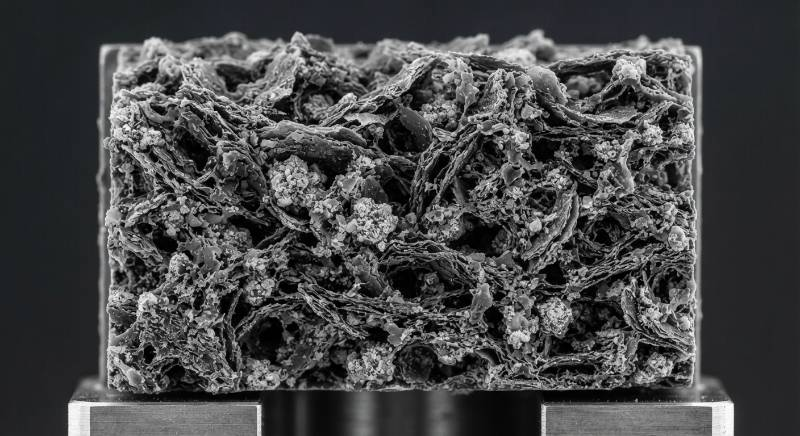
Pure aluminum naturally develops an adherent, continuous dielectric film of aluminum oxide (Al2O3) within milliseconds of electrolyte exposure. This native passivating layer prevents electron transport, rendering pure aluminum chemically inert and useless as a sacrificial galvanic anode.
To overcome this passivation barrier, marine-grade aluminum anodes rely on precise micro-alloying. The addition of 0.015% to 0.030% Indium (In) or trace Gallium (Ga) disrupts the lattice structure of the oxide film.
Indium ions migrate into the outer grain boundaries, creating localized defects that allow aggressive chloride (Cl-) ions in seawater to sustain active dissolution. Zinc is naturally immune to such self-passivation in seawater, though it forms non-conductive zinc carbonate and hydroxide crusts when exposed to elevated temperatures (>50 °C) or variable freshwater inputs.
Industrial Specifications & Manufacturing Standards
Galvanic anode performance depends strictly on chemical composition and trace impurity thresholds. Intergranular impurities such as Iron (Fe), Copper (Cu), and Silicon (Si) can form internal micro-galvanic cells, accelerating self-corrosion and causing catastrophic anode passivation.
Engineering compliance for marine structural cathodic protection is governed by standards established by AMPP (Association for Materials Protection and Performance), ASTM International, and DNV guidelines.
Engineering Insight: Impurity Limits in Zinc Specifications
Per ASTM B418 (Standard Specification for Cast and Wrought Galvanic Zinc Anodes), Type I zinc for seawater usage requires an iron concentration strictly below 0.005%. If iron levels exceed 0.005%, FeAl and FeZn intermetallic particulates precipitate, increasing internal electrical resistance and triggering early anode passivation.
For offshore projects, DNV-RP-B401 (Cathodic Protection Design) sets the global engineering framework for calculating anode mass, polarization currents, and expected service lives on platforms, submarine pipelines, and subsea jackets.
Under MIL-DTL-24779 (SH), aluminum anodes micro-alloyed with Zinc (4.0 - 6.5%) and Indium (0.014 - 0.020%) must demonstrate an electrochemical efficiency of no less than 85% after 14-day continuous galvanic discharge testing in artificial seawater.
Environmental Salinity & Operational Water Types
Water resistivity determines ionic current transport from the anode face to the exposed structural steel. As salinity drops, electrolyte resistivity increases exponentially, fundamentally changing anode discharge behavior.
Open Ocean Saltwater (Resistivity: 15 to 30 Ω·cm): High conductivity allows both zinc and aluminum to function effectively. Aluminum-Indium provides superior electrochemical capacity and reduced hull weight.
Brackish Estuaries & River Mouths (Resistivity: 50 to 300 Ω·cm): Aluminum retains an advantage due to its slightly higher open-circuit driving potential (-1.10 V vs. -1.05 V for zinc). Zinc often develops passive oxy-hydroxide surface films in low-chloride conditions, reducing current output.
Pure Freshwater (Resistivity: 1,000 to 10,000+ Ω·cm): Neither zinc nor aluminum delivers sufficient driving voltage across high-resistance freshwater paths. Magnesium anodes (-1.55 V closed-circuit potential) are required to polarize steel in pure freshwater environments.
Operating aluminum anodes in continuous, enclosed freshwater cooling circuits can cause passivation due to the absence of chloride-driven activation. For specialized maritime assets operating across diverse water chemistries, explore robust alloy systems in China Titanium Factory Products to select appropriate material grades for aggressive media.
Life-Cycle Cost, Weight Ratios, and Marine Transport Efficiency
Aluminum sacrificial anodes provide an immediate mass reduction advantage over zinc. Because aluminum's practical current capacity (2,600 Ah/kg) is roughly 3.3 times that of zinc (780 Ah/kg), an equivalent structural protection design requires only 30% of the physical anode mass.
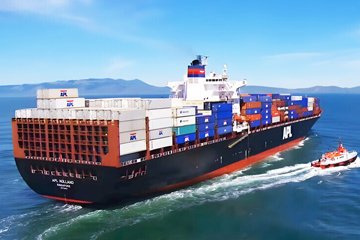
On a 300-meter commercial container vessel or bulk carrier requiring 15,000 kg of zinc protection, the equivalent aluminum system requires approximately 4,550 kg. This sheds over 10 metric tons of deadweight, reducing draft resistance and fuel consumption over long transit cycles.
Environmental and port regulations increasingly disfavor zinc. Standard ASTM B418 Type I zinc contains up to 0.15% Cadmium (Cd) to refine grain boundaries and prevent self-passivation. As the anode corrodes, toxic cadmium compounds leach directly into sensitive marine harbor beds, running afoul of zero-discharge environmental standards.
The CTF Cathodic Transition Matrix: Sizing and Selection Protocol
To streamline cathodic design for naval architects and pipeline integrity engineers, we developed The CTF Cathodic Transition Matrix. This four-step engineering workflow determines optimal sacrificial mass or indicates when an asset must transition to permanent impressed current systems.
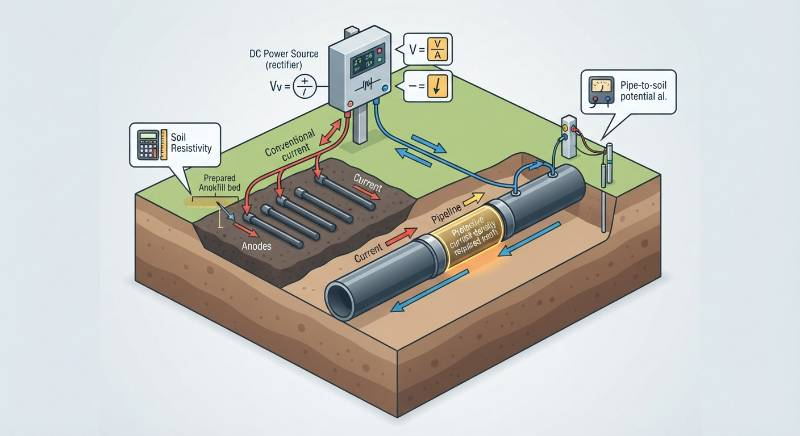
Step 1: Environmental Electrolyte Assessment: Measure bulk water resistivity (ρ in Ω·cm), operating temperature range, and average flow velocity to calculate the electrolyte ohmic drop.
Step 2: Polarizing Current Demand Calculation: Determine total wetted steel surface area (Ac in m2), coating breakdown factor (fc), and baseline current density demand (icd in mA/m2) per DNV-RP-B401 guidelines:
Ireq = Ac × fc × icdStep 3: Geometry & Ohmic Attenuation Sizing: Compute single-anode resistance using McCoy's formula for flush-mounted stand-off anodes:
Ra = (ρ / 2S) × (1 + (2w / πL) × ln(2L / w))
Verify that individual anode discharge Ia = (Ecathode - Eanode) / Ra meets local protection requirements.Step 4: Total Anode Mass and Service Life Verification: Calculate total required alloy mass (M in kg) over design lifespan (t in years, with 8,760 hours/year) based on practical electrochemical capacity (ε in Ah/kg):
M = (Ireq × t × 8760) / (u × ε)
where u is the anode utilization factor (typically 0.80 to 0.85).
Beyond Sacrificial Alloys: Upgrading to MMO Titanium ICCP Systems
While zinc and aluminum sacrificial anodes serve small hulls and localized components well, large commercial vessels, offshore wind foundations, and high-temperature submerged pipelines face limitations with consumable systems. High sacrificial anode volume creates hydrodynamic drag, adds dry-dock weight, and requires recurring replacement every 3 to 5 years.
Modern offshore structures increasingly transition to Impressed Current Cathodic Protection (ICCP) systems utilizing Mixed Metal Oxide (MMO) coated onto an ASTM B265 Grade 1 or Grade 2 Titanium substrate.
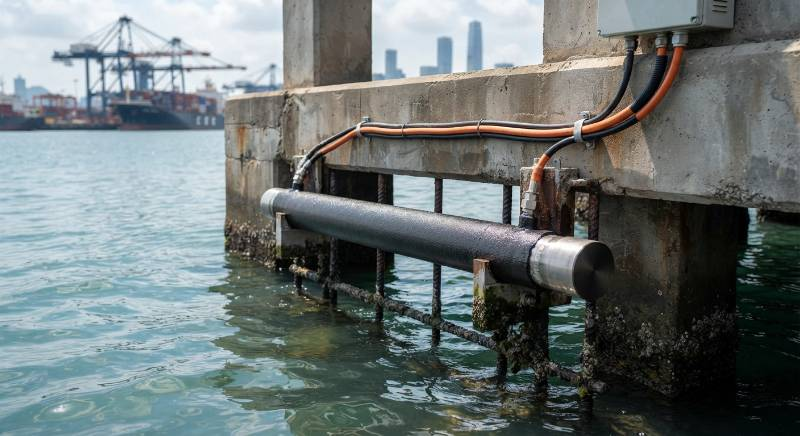
MMO titanium anodes combine an electrocatalytic coating of Iridium Oxide (IrO2) and Tantalum Oxide (Ta2O5) with a ductile, corrosion-proof titanium core. Under impressed direct current, the MMO catalyst drives the evolution of chlorine and oxygen without consuming the titanium substrate.
Ultra-Low Consumption Rate: MMO coatings consume at less than 1.0 to 4.0 mg/A·year, delivering operational lifespans exceeding 25 to 50 years without anode replacement.
Hydrodynamic Integration: Flush-mounted MMO titanium disc or ribbon anodes eliminate hull drag, lowering vessel fuel consumption.
Dynamic Current Control: ICCP control panels continuously modulate output voltage to match fluctuating vessel speeds, coating wear, and variable salinities.
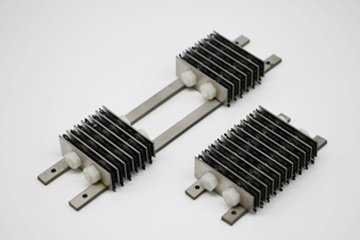
For custom engineering consultations regarding dimensionally stable MMO titanium ribbon, tubular, or plate anodes, Contact Marine Engineering Team to evaluate our custom-manufactured substrate geometries.
Frequently Asked Questions (FAQ)
Can you mix zinc and aluminum sacrificial anodes on the same marine hull?
Mixing zinc and aluminum anodes on the same electrically continuous hull structure is not recommended. Because aluminum operates at a more electronegative closed-circuit potential (-1.10 V vs. Ag/AgCl) than zinc (-1.05 V vs. Ag/AgCl), the aluminum anodes will polarize the zinc. This forces the aluminum anodes to consume prematurely while the zinc anodes remain passive until the aluminum is exhausted.
Why do aluminum anodes sometimes passivate in brackish water?
Aluminum anodes require a threshold concentration of chloride ions to sustain activation of the Indium micro-alloying dopants. In brackish water or muddy river delta sediments with very high electrical resistivity and low salinity, the rate of chloride disruption falls below the rate of passive aluminum oxide formation, creating a resistive dielectric barrier that drops protection current.
Does zinc undergo potential reversal at elevated temperatures?
Yes. In aerated saline water exceeding 50 °C (common in heat exchanger tubing, marine ballast heating coils, and hot water storage compartments), zinc experiences a crystallographic transformation in its corrosion product layer. The resulting zinc hydroxide/carbonate structure becomes cathodic to steel, causing the zinc to reverse polarity and rapidly accelerate corrosion of the underlying steel substrate.
When does an MMO Titanium ICCP system become more cost-effective than aluminum anodes?
MMO Titanium ICCP systems are more cost-effective on structures with a design service life exceeding 10 to 15 years, assets with wetted surface areas greater than 2,000 m2, or high-speed vessels where sacrificial anode drag increases fuel consumption. ICCP eliminates recurring dry-dock anode replacements, lowering total lifecycle cost over decades.